REVIEW · ALBERTA
Yoho National Park Self-Guided Driving Audio Tour
Book on Viator →Operated by Guide With Action · Bookable on Viator
GPS-guided audio makes the park feel bigger. Yoho National Park is one of Canada’s smaller parks on paper, but the drive still packs in major views, waterfalls, and geology—especially when you get guided, hands-free storytelling by the road.
I especially like the offline-ready setup and location-based playback. You can start whenever you want, pause for photos, and not worry about dead zones because the tour is designed to run without cellular or Wi‑Fi.
One thing to consider: a Yoho National Park entrance pass isn’t included. Also, the tour needs you to download and set it up on strong Wi‑Fi first and then launch the app at the starting point, or you may end up with an audio hiccup.
In This Review
- Quick highlights you’ll feel on the road
- Yoho National Park by car: why this route feels less rushed
- Price and time: what $14.99 per group buys you
- Getting started without frustration: app, offline use, and audio
- Stop-by-stop drive: from Kicking Horse Pass to Emerald Lake
- Kicking Horse Pass: the name behind the crossing
- Sherbrooke Lake Trailhead: solitude requires time
- Lower Spiral Tunnel Viewpoint: how trains beat the mountains
- Takakkaw Falls: a detour with a seasonal clock
- Wapta Mountain: First Nations names and a classic climb
- Burgess Shale: the science stop that’s still visual
- Natural Bridge: the river’s speed switch
- Emerald Lake to finish: Tom Wilson’s naming story
- The best choices to match your mood (and your legs)
- Timing and seasons: don’t let Takakkaw Falls trick you
- Value check: this is best for DIY road-trippers, not just sightseers
- Should you book the Yoho National Park self-guided driving audio tour?
- FAQ
- Do I need a park pass for Yoho National Park?
- How long is the driving audio tour?
- Is the audio tour available offline?
- How do I start the tour if nobody meets me?
- What does the price include?
- Can I get a refund if I cancel?
Quick highlights you’ll feel on the road
- Buy once, use across trips: The tour is described as buy once for a year, and it also notes lifetime access/no expiry for using it anytime.
- Over 50 miles with 27+ stories: It’s built around a real driving route, not a scatter of random stops.
- Offline maps + hands-free audio: No signal doesn’t stop the stories, and the audio plays automatically based on your location.
- Great value per car: It’s priced per group (up to 4 people), which can beat bus or guide costs on a road trip.
- Mix of quick viewpoints and one real hike: You’ll get short pulls to look, plus the option to earn your solitude at Sherbrooke Lake.
- Seasonal timing for Takakkaw Falls: The waterfall detour depends on the road being open (July–September).
Yoho National Park by car: why this route feels less rushed
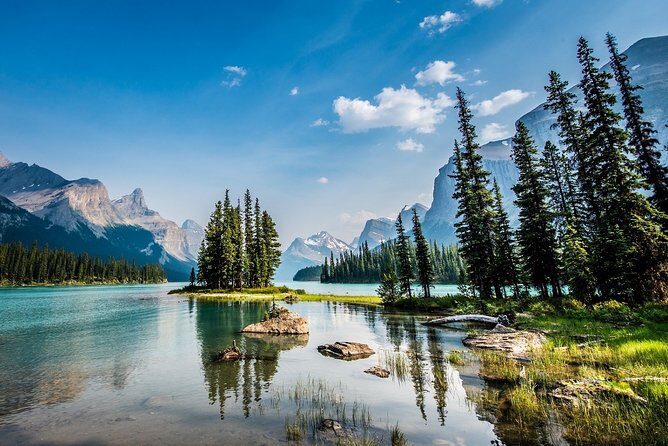
If you’ve ever driven through Banff and felt like you were always catching up, this kind of self-guided Yoho tour works because it gives you permission to slow down. Yoho is over 500 square miles, with wildlife and big scenery, but it’s still easy to experience at a relaxed pace when your “guide” is listening in your car and calling out what you’re seeing.
This route also helps you connect the dots. You don’t just stop at a viewpoint—you get the story behind Kicking Horse Pass, the Spiral Tunnel engineering problem, and why places like Burgess Shale matter to Canadian science.
And because the tour is private for your group (no shared bus crowds), the stops feel like you’re taking them on your own schedule.
You can also read our reviews of more guided tours in Alberta
Price and time: what $14.99 per group buys you
The price is $14.99 per group (up to 4), which is a big part of the value. If you’re road-tripping with a couple friends or family members, you’re not paying per person for a narrated route—one purchase covers the car.
The tour duration is listed as about 1 to 2 hours. That doesn’t mean you’ll be stuck in the car the whole time. It means the “main loop” of story points is designed to fit a half-day window, with optional hikes like Sherbrooke Lake if you want to go longer.
A practical way to plan: treat the tour as a driving backbone. Use it to know what’s coming next, then stay longer only at the stops that grab you.
Getting started without frustration: app, offline use, and audio
This is self-guided, so there’s no guide waiting at your parking spot. After booking, you get an email/text with instructions and a password. Then you download the Action’s Tour Guide app and enter the password.
Two setup tips matter a lot:
- Download while you have strong Wi‑Fi/cellular. The tour works offline after that, but you need the initial download to go smoothly.
- Launch the tour at the starting point. The app is meant to guide you to the start if needed, but the key is starting the correct tour from the correct location so audio cues line up with where you are.
For sound, you have options:
- Connect your phone to your car stereo via Bluetooth, USB, or AUX.
- If you step out for short walks, headphones can help (especially when you’re not sitting in the driver’s seat).
- Playback is compatible with Apple CarPlay; Android Auto support is noted as coming soon.
- Recommended devices are iPhone iOS 15+ and Android version 9+ (and tablets with GPS/cellular).
Also remember: the tour plays based on location and road position, so it’s worth following the planned route and speed limits for the best experience.
Stop-by-stop drive: from Kicking Horse Pass to Emerald Lake
The route is described as over 50 miles long with more than 27 audio stories. Many stops include short story segments (about 10 minutes each in the pacing), but what you do at the pullouts is up to you.
Below is what you can expect at each major stop—and the trade-offs so you can decide fast.
Kicking Horse Pass: the name behind the crossing
You start by driving through Kicking Horse Pass, and the audio connects the route to how the Kootenay people used these mountain crossings long ago. Then it turns to the big question: how did the pass get the name Kicking Horse?
This stop is mostly about perspective. Instead of treating the road like a modern shortcut, you’re invited to see it as part of a much longer human route through the Rockies.
A few more Alberta tours and experiences worth a look

Sherbrooke Lake Trailhead: solitude requires time
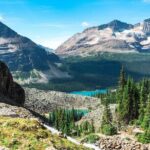
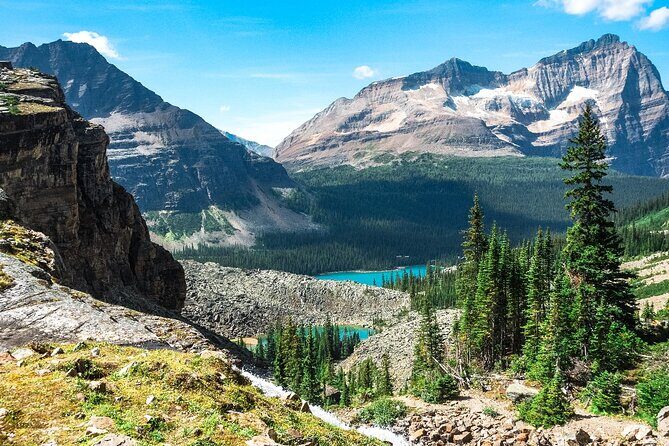
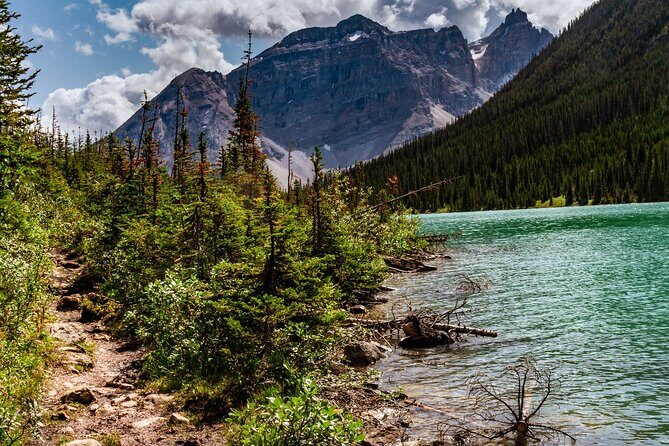
Next comes Sherbrooke Lake Trailhead, the setup for a hiking option. The trail is six miles long and takes at least two hours, and the reward is a more secluded lake tucked at the base of two mountains.
Here’s the consideration: this is the tour’s only clearly “serious” commitment. If you’re short on time, skip the hike and enjoy the drive and viewpoints instead. If you want quieter moments away from crowds, this is your best bet.
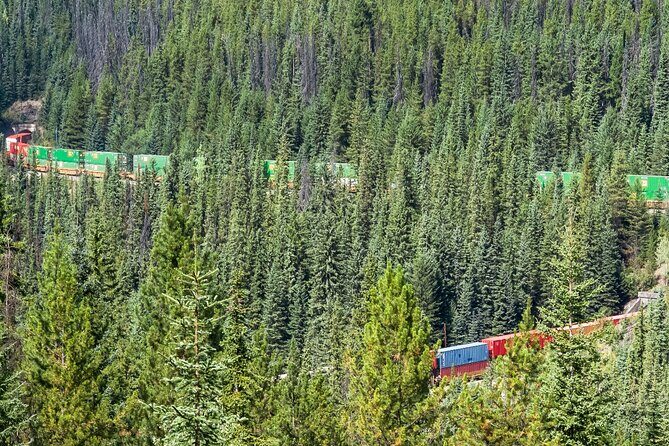
Lower Spiral Tunnel Viewpoint: how trains beat the mountains
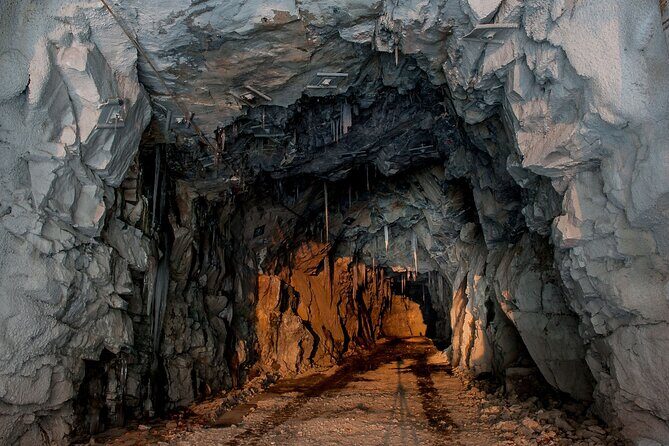
At Lower Spiral Tunnel Viewpoint, the audio focuses on a real 1880s problem: how to get a steam-powered Canadian Pacific Railway train with about 20 cars up and over the Rockies (noted as around 10,000 feet tall).
It’s tied to Canadian Prime Minister John MacDonald and the engineering promise that it would happen—then it lands on how the railway solved the thorny part of the terrain.
This stop works especially well if you like “why it had to be designed this way” stories. It also gives you something useful to look for—structure, layout, and how the terrain shapes the solution.
Takakkaw Falls: a detour with a seasonal clock
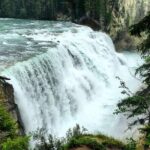
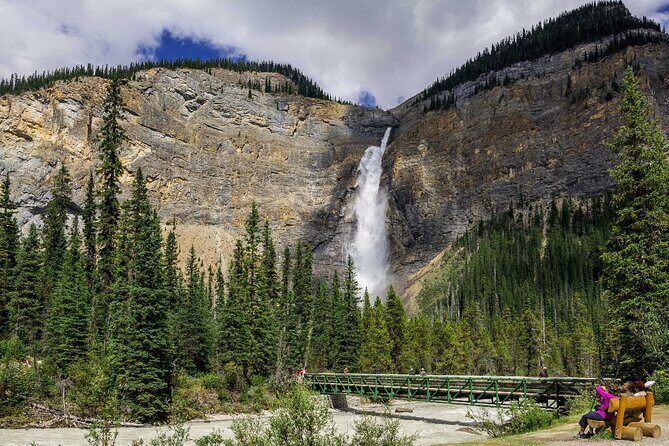
Up ahead is Takakkaw Falls, with an optional detour. The road is only open July through September, and the detour takes about 15 minutes each way.
The payoff is size: the falls tower at about 1,200 feet, and the audio promises you can get surprisingly close. If you’re traveling outside that window, you’ll need to treat this as a skip, not a backup plan.
Wapta Mountain: First Nations names and a classic climb
Then comes a sighting of the top of Wapta Mountain. It’s listed at 9,114 feet, and the audio ties the name to First Nations language. There’s a prompt about what Wapta means in the Nakoda language—and the story will explain it in the moment.
The audio also mentions the first recorded climb in 1901 by clergyman James Outram and J.H. Scattergood, with a Swiss guide.
This stop is a reminder that naming and exploration both have histories—and in this case, the mountain’s name isn’t just a European label dropped into the map.
Burgess Shale: the science stop that’s still visual
Burgess Shale is next, off to the side near Mount Field, and the audio calls it one of the most important paleontological finds in Canada. It’s described as a huge swath of sedimentary shale loaded with fossils.
Even if you don’t think of yourself as a geology person, this is a strong stop because it turns rocks into time. You’re not just looking at a view—you’re seeing a place that helps answer deep questions about life in Canada’s past.
Natural Bridge: the river’s speed switch
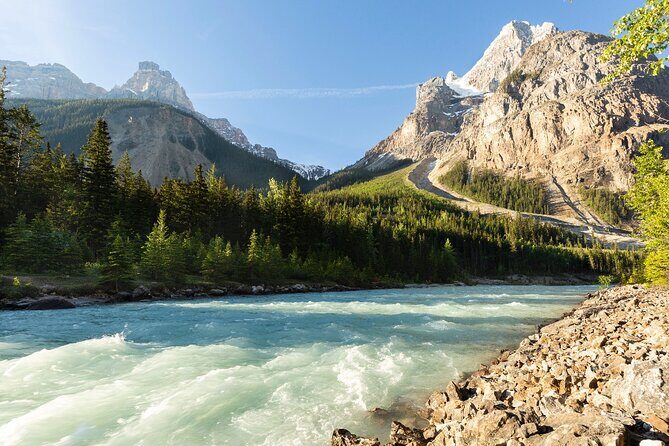
At Natural Bridge, you’ll see a rock span across the width of the Kicking Horse River. The story explains how it formed by looking at how the river behaves here.
The audio describes flatter, slower flow near Field, then a shift where the river starts a downhill journey, moving faster and getting rougher as it joins the Amiskwi River.
This stop is short, but it gives you a mental model for how water shapes land. It’s one of those moments where a quick pull-off suddenly feels like understanding.
Emerald Lake to finish: Tom Wilson’s naming story
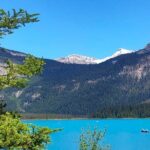
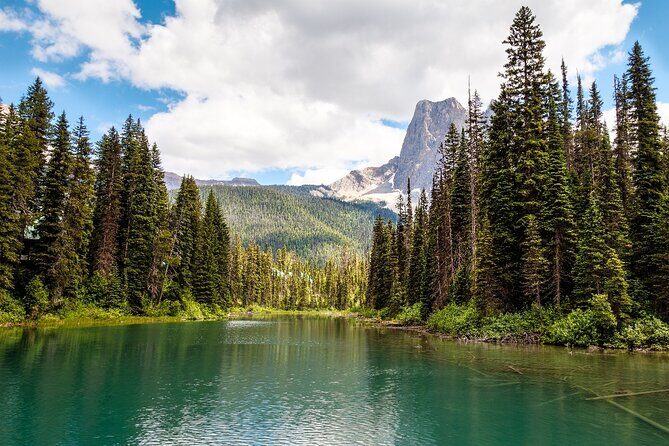
The tour ends at Emerald Lake, and the audio closes with Tom Wilson, described as the first European settler to lay eyes on the lake and also the one who named it.
The story notes that historians are pretty sure he isn’t exaggerating, which gives you a satisfying finish line that ties exploration, naming, and the lake’s fame together.
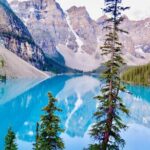
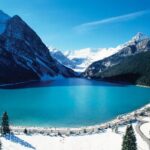
If you want a natural “bookend” to the day, this is it: you start in mountain pass terrain and end on a glacial lake payoff.
The best choices to match your mood (and your legs)
This tour is flexible in a way that fits real travel days. If you want easy wins, stick to the short viewpoint stops and keep your hike optional.
If you want a more memorable effort, prioritize Sherbrooke Lake. That’s where you get distance from the road and the “less crowded” feeling people look for in Yoho.
For people who care about learning while driving, the strongest sequence is the engineering-and-geology combo: Lower Spiral Tunnel Viewpoint → Burgess Shale. Those stories turn distant mountain features into something you can understand in minutes.
Timing and seasons: don’t let Takakkaw Falls trick you
Takakkaw Falls is a classic “worth checking” stop, but it has a catch. The road detour is only open July through September. If you’re outside those months, you’ll need to plan on either skipping it or spending that time elsewhere along the route.
The good news is that even with Takakkaw Falls unavailable, the rest of the drive still covers major sights and story themes, from pass history to paleontology.
Value check: this is best for DIY road-trippers, not just sightseers
If you’re the type who likes to stop when something catches your eye, this tour is a good match. The audio is hands-free and plays automatically based on location, so you can keep your attention on scenery and pullouts instead of tapping your phone every few minutes.
It also helps that the tour is designed to work offline, and it’s priced per car/group. On a road trip, that combination can turn a short drive into an experience that feels like time well spent rather than a list of quick photo stops.
The only big “gotcha” is technical behavior: the negative feedback you might see is often about the guide not working. The provider’s troubleshooting emphasis is clear—download first on good Wi‑Fi, preview/setup, and then launch the tour at the starting point so the GPS cues have the right anchor.
Should you book the Yoho National Park self-guided driving audio tour?
I’d book it if you want a low-stress Yoho day where history and science show up right when you’re looking at the relevant place. It’s especially good for groups up to 4 because the price per group is a strong value on a short-to-medium drive.
I would not book it if you’re likely to travel without planning for setup. You’ll need to download on good connectivity and you’ll need a Yoho park pass at the entrance. And if you hate apps or GPS-based triggers, you might find the self-guided format annoying.
If you want a practical compromise: use this tour as your structure, then give yourself permission to linger at the stops that pull you in—especially Sherbrooke Lake if you have the time.
FAQ
Do I need a park pass for Yoho National Park?
Yes. A Yoho National Park entrance pass is required and it is not included with the tour. You can purchase it at the park entrance or online.
How long is the driving audio tour?
The tour is listed as about 1 to 2 hours to complete.
Is the audio tour available offline?
Yes. It includes offline maps and is designed to work without cellular or Wi‑Fi after you download the tour.
How do I start the tour if nobody meets me?
You’ll open the Action’s Tour Guide app on-site, start the correct tour version, go to the starting point, and the first story should begin automatically based on your location. You follow the audio cues from there.
What does the price include?
The price is per group (up to 4) and covers the audio tour. Park passes are not included. The audio includes storytelling, location-triggered playback, and the ability to pause/start and explore at your own pace.
Can I get a refund if I cancel?
You can cancel for a full refund if you cancel at least 24 hours before the experience’s start time. If you cancel within 24 hours, the amount paid is not refunded.