REVIEW · MONTREAL
Exclusive Tour of the Montreal Olympic Games by MTL76
Book on Viator →Operated by Le Montréal olympique · Bookable on Viator
A visit to Olympic Park feels like stepping into a turning point. This guided walk connects the 1976 Games to Montreal’s ambitions, big moments, and a few surprising stories. You’ll move stop to stop around the most recognizable features of the complex, with history explained clearly as you go.
I really like how the tour is organized around specific Olympic landmarks instead of random photo stops. Starting at the Olympic cauldron and rings, you get the sweep of how the Games evolved from ancient origins to the modern era—then the story narrows to Montreal’s 1976 edition. The guide’s energy also comes through fast, especially when you’re standing on key sites tied to major performances.
One thing to plan around: Olympic Stadium is under major renovations, so you won’t be able to enter the building. If you were hoping for stadium interior access, this is mostly an exterior-and-esplanade experience for the full 1 hour 30 minutes.
In This Review
- Key highlights you’ll feel right away
- Why the 1976 Olympics story still plays well in Montreal
- Start and finish locations: easy to plan, flexible after the tour
- Stop 1: Olympic cauldron and rings for the Games’ big origin story
- Montreal secured the Games: the Esplanade and Jean Drapeau
- The former athletes’ village: political stakes and unexpected twists
- Olympic Stadium from the foot: construction secrets and lasting legacy
- Nadia Comaneci Square: performances you’ll actually be able to picture
- Finish at the Olympic rings: photos and closure
- Price and timing: what $22.41 buys you for 1.5 hours
- Who this walking tour is best for
- The guide factor: energy and Olympic know-how
- Should you book the Exclusive Tour of the Montreal Olympic Games?
- FAQ
- How long is the Montreal Olympic Games tour?
- What’s the price per person?
- What language is the tour offered in?
- Where does the tour start and where does it end?
- Is admission included?
- Can I enter the Olympic Stadium during the tour?
- How many people are in each tour group?
- Do I need a printed ticket?
- Is there free cancellation?
- Is the tour near public transportation and suitable for most people?
Key highlights you’ll feel right away
- Small group size (max 10): easier conversation and more attention from the guide
- Olympic cauldron + rings start: a strong first stop with instant context
- Jean Drapeau and Montreal’s bid story: how the Games were secured, not just what happened
- Nadia Comaneci Square: performances that defined the tournament get explained on-site
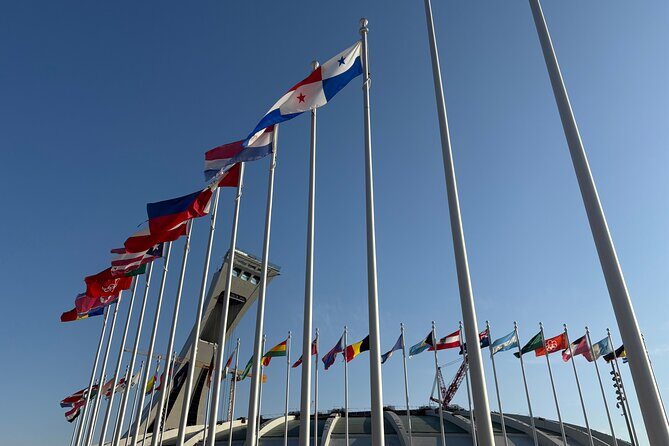
- Olympic Stadium viewing only: construction secrets and legacy, without entering
Why the 1976 Olympics story still plays well in Montreal
Montreal’s Olympic complex isn’t just architecture. It’s an explanation in concrete form. When you visit with a guide, you start noticing how each location maps to a theme: ambition, politics, pressure, and then pure athletic achievement.
This tour keeps that focus. You get the broad thread first—the evolution of the Games from ancient origins to the modern Olympics—then the tour zeroes in on the Montreal edition. That matters because 1976 wasn’t only about sport. The Games came with political stakes and unexpected twists, and the guide ties that context to where you’re standing.
If you like learning by walking, you’ll appreciate the way the stops are chosen. Each one is tied to a moment you can picture: the beginning at the rings, the build-up around the Olympic Park, the athlete-related setting at the former village area, and the performance legacy at Nadia Comaneci Square.
You can also read our reviews of more tours and experiences in Montreal.


Start and finish locations: easy to plan, flexible after the tour
The tour starts at 2705 Bd Pie-IX, Montréal, QC H1V 2E8. You finish at Aréna Maurice-Richard, 2800 Rue Viau, Montréal, QC H1V 3V4. That end point is handy because it gives you an easy next step, whether you’re heading back into the city or hopping to a different plan.
The route is designed so the guide can help you after the walk. At the end, the guide can escort you back to the initial meeting point, help you reach the nearest metro station, or point you toward your next activity. That kind of small support is useful when you don’t want to re-orient yourself on the fly.
A couple practical notes that help you feel prepared:
- It’s offered in English.
- It’s near public transportation, so you’re not locked into a car or taxi.
- Service animals are allowed, and most travelers can participate.
Stop 1: Olympic cauldron and rings for the Games’ big origin story
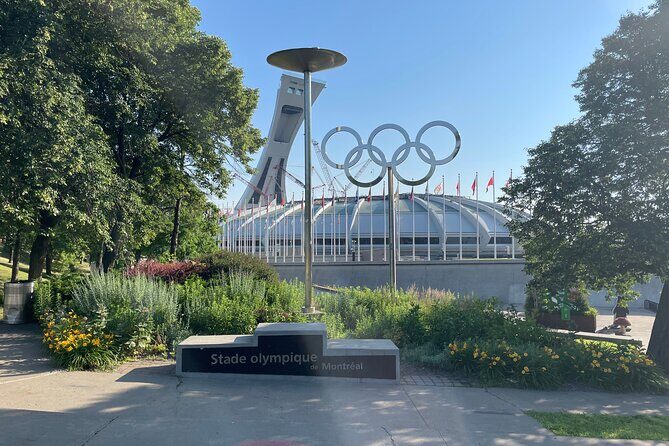
You begin next to the Olympic cauldron and the rings. This is a smart opener because these symbols are the simplest way to understand what the Olympics are trying to do. The guide gives a quick history that starts with ancient origins and tracks how the Games evolved over time.
Why this works: it gives your brain a framework before the tour gets specific. Without that framing, 1976 can feel like a date on a sign. With it, you’re connecting why Montreal’s Olympic Park was built the way it was: it’s not only a venue, it’s a statement.
And yes, it’s also a strong visual start. You’re in the right place for photos immediately, and you’ll understand what the imagery means before you start snapping pictures.
Montreal secured the Games: the Esplanade and Jean Drapeau
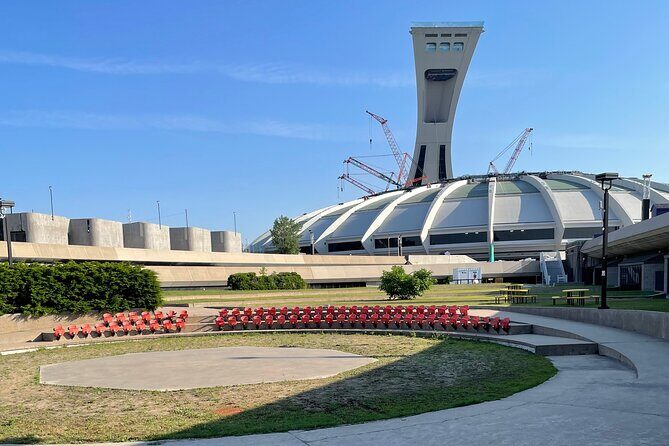
From the opening symbols, the walk shifts to the Esplanade of the Olympic Park. Here, the guide explains how Montreal and its mayor at the time, Jean Drapeau, managed to secure the Olympics.
This is where the tour becomes more than sightseeing. You get the sense that hosting the Olympics takes politics, planning, and public backing—before any medal ceremonies ever happen. Even if you know the Games happened in Montreal, hearing how they were secured helps you understand the stakes behind the physical complex you’re about to see.
If you enjoy civic history—how a city sells a big project to the world—this is one of the stops you’ll likely remember.
The former athletes’ village: political stakes and unexpected twists
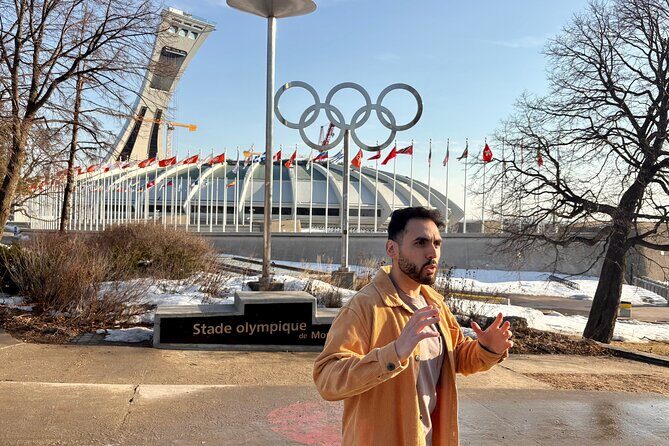
Next, you stop in front of the former athletes’ village. This is one of the more thought-provoking parts of the walk because it’s tied to how the Games unfolded, not only how they were designed.
The guide places this stop in the context of the 1976 edition, explaining the political stakes and unexpected twists that shaped what happened around the Games. Standing here makes the stories feel grounded. You’re not just hearing about events in the abstract—you’re at the kind of site where athletes and teams would have had routines, stress, and logistics.
It also gives you a realistic angle. Olympic stories often focus on medals and headlines. This approach reminds you that there’s always a behind-the-scenes side: planning, uncertainty, and sudden changes.

Olympic Stadium from the foot: construction secrets and lasting legacy
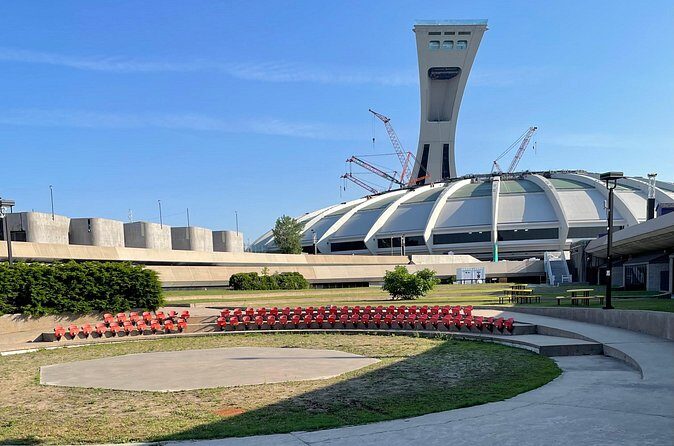
At the foot of the Olympic Stadium, the guide shares surprising anecdotes and secrets about the structure—how it was built and the legacy it’s left behind.
This is the big “wow” moment for a lot of people because the stadium looks bold from outside, even before you know its backstory. When the guide explains the complex construction and why the stadium’s design mattered, you start seeing it as more than a landmark. You start seeing it as engineering plus ambition plus risk.
Your important limitation: you can’t enter Olympic Stadium. The stadium is undergoing significant renovations, so the tour focuses on what you can learn from the exterior area and the surrounding viewpoints.
If you’re okay with an outdoor, exterior-focused experience here, you’ll still get a lot. If you need interior access to feel satisfied, you might want a different kind of Olympic visit.
Nadia Comaneci Square: performances you’ll actually be able to picture
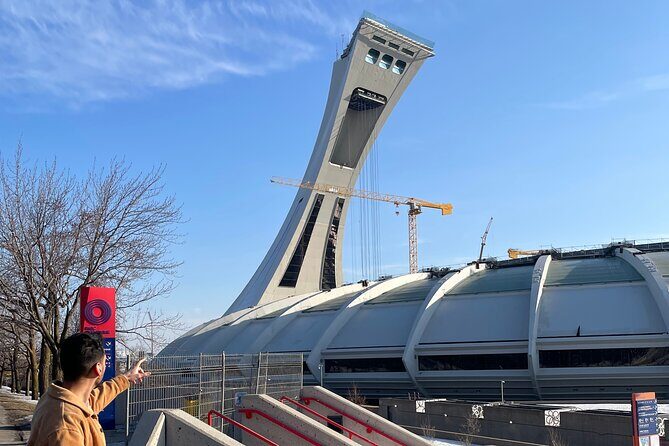
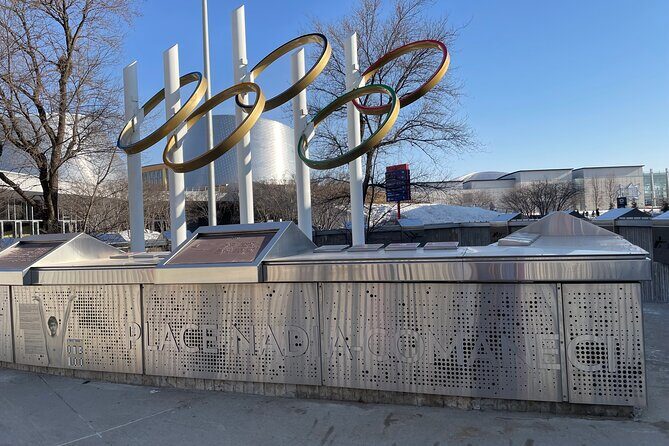
Then the tour reaches Nadia Comaneci Square, where the guide connects you to the unforgettable performances that defined the 1976 Games.
This stop is valuable because it turns names and achievements into place-based memory. Instead of hearing about greatness in a distant way, you’re standing at a dedicated site where the legacy is recognized.
Even if you don’t know the details of the performances already, the guide’s pacing helps you follow what made those moments stand out. The square gives you a clear anchor for the sporting side of the story, right after the more political and logistical context earlier in the walk.
Finish at the Olympic rings: photos and closure
The tour ends in front of the Olympic rings—where it all began. This is a simple move, but it brings the experience full circle. After history, politics, the athlete setting, and stadium legacy, you’re back at the symbol that summarizes the idea of the Games.
It also gives you a natural photo moment with less rushing. By the end, you know what you’re photographing, and you can frame your pictures with more meaning than just the background.
If you like ending your tours with a clear “done” feeling (instead of being dropped somewhere random), this wrap-up makes the experience feel complete.
Price and timing: what $22.41 buys you for 1.5 hours
At $22.41 per person, you’re paying for a guided, structured 1 hour 30 minutes walking tour that includes admission to the activity, with all fees and taxes covered in the reservation.
Here’s how I judge the value:
- You’re not just getting general information. The tour is organized around major Olympic sites in a stop-by-stop format, so you’re paying for a guided interpretation.
- The group size is limited to up to 10 travelers, which helps you ask questions and stay engaged.
- You get an included ticket component, so you’re not constantly paying add-ons during the tour.
It’s also a good length for a first pass. Ninety minutes is long enough to connect the story, but not so long that you feel drained. And because the start and end points are both in Montreal’s Olympic area, it’s a practical add-on for a half-day plan.
The tour is offered in English, so that’s another value factor if you want the story delivered clearly instead of relying on audio apps.
Who this walking tour is best for
This one fits best if you like:
- Olympic history you can see in real places (cauldron, rings, stadium exterior, Nadia Comaneci Square)
- A guide who explains the 1976 Olympics as both sport and world events
- A small group format where the guide can actually react to questions
It’s also a solid choice if you’re short on time and want a focused, low-planning activity. The meeting points are fixed, the duration is predictable, and the guide can help you with where to go next at the end.
You might consider skipping or pairing it with something else if:
- You specifically want to go inside the stadium. The tour can’t provide that, since the Olympic Stadium entry is closed for renovations.
The guide factor: energy and Olympic know-how
The reviews highlight the guide’s passion and presentation, and that makes sense for a tour like this. When you’re walking around symbols and architecture, the guide’s tone matters. You want someone who can connect what you see to why it matters.
In particular, the guide Marc-Élie gets strong praise for being deeply into Olympic themes and for giving an informative, engaging explanation. That kind of enthusiasm tends to be the difference between hearing facts and actually understanding the story.
The other review feedback also emphasizes that the visit covers both political and sporting levels. That matches what the tour’s stop sequence suggests: it isn’t just medal trivia. It’s context with a walking route that keeps you oriented.
If you enjoy learning through people rather than plaques, this tour’s format supports that.
Should you book the Exclusive Tour of the Montreal Olympic Games?
I’d book it if you want a short, guided way to make Montreal Olympic Park click. The small group size, the stop-by-stop structure, and the focus on the 1976 Olympics as both sport and politics are the real reasons. You’ll come away knowing the names and symbols, but also the context that gives them weight.
Skip it only if stadium interior access is a must for you. Since entry isn’t possible due to renovations, this is about what you can learn and see from the park and surrounding sites.
If you’re building a Montreal plan and want one experience that connects iconic architecture to a specific Olympic moment, this is a very practical pick.
FAQ
How long is the Montreal Olympic Games tour?
It’s approximately 1 hour 30 minutes.
What’s the price per person?
The price is $22.41 per person.
What language is the tour offered in?
The tour is offered in English.
Where does the tour start and where does it end?
It starts at 2705 Bd Pie-IX, Montréal, QC H1V 2E8 and ends at Aréna Maurice-Richard, 2800 Rue Viau, Montréal, QC H1V 3V4.
Is admission included?
Yes. Admission to the activity is included, and all fees and taxes are covered in the reservation.
Can I enter the Olympic Stadium during the tour?
No. The Olympic Stadium is under significant renovations, so entry isn’t possible.
How many people are in each tour group?
The tour has a maximum of 10 travelers.
Do I need a printed ticket?
No. You’ll use a mobile ticket.
Is there free cancellation?
Yes. You can cancel for a full refund up to 24 hours before the experience starts.
Is the tour near public transportation and suitable for most people?
Yes, it’s near public transportation, and most travelers can participate. Service animals are allowed.