REVIEW · VANCOUVER
Vancouver Old Town Treasure Hunt: Self-Guided Walking Game
Book on Viator →Operated by Questo · Bookable on Viator
Vancouver turns into a puzzle map. This self-guided smartphone treasure hunt is a budget-friendly way to explore old town Vancouver at your own pace, with offline functionality that helps when signal is spotty. I love that it nudges you to look closely at architecture instead of just rushing by, and I also like the storyline based on Vancouver’s Gold Rush history. One thing to consider: if you’re trying to use multiple phones in the same group, downloading or getting everyone synced can be a small hassle.
You’ll start near Burrard Street and work your way toward Gastown, finishing at Maple Tree Square by the waterfront area. There’s no live guide counting your steps—just a phone quest with 14 puzzle-based challenges and a step-by-step flow that helps you keep moving.
In This Review
- Key highlights to know before you play
- Price and time: why $7.20 can actually feel fair
- How the Questo app works on the ground
- Where you start, where you finish, and how to plan your walk
- A smart on-foot tip
- Marine Building: Art Deco looks better when you slow down
- Howe and Cordova: the customs warehouse story in 1911–1913
- Waterfront Station: Canadian Pacific’s transcontinental gateway
- The steam-powered clock: built 1977, still part of the charm
- The Dominion Building: Beaux-Arts drama at street level
- Sun Tower: architecture tied to Louis D. Taylor and the newspapers
- Sam Kee Building: Chinese community history at Pender and Carrall
- Gassy Jack Deighton: Gastown’s origin story (and the reassessment)
- Gaoler’s Mews: first jail history and the 1886 fire
- The Alibi: a heritage site ending at food, beer, and culture
- The best way to play with friends (and avoid the common hiccups)
- Who this treasure hunt is best for
- Quick planning notes so your day stays smooth
- Should you book this Vancouver Old Town Treasure Hunt?
- FAQ
- What does the Vancouver Old Town Treasure Hunt cost?
- How long does the self-guided walking game take?
- Is there a live tour guide included?
- Can I play it offline?
- Where do I start and where does it end?
- What’s included in the quest?
- What landmarks are part of the route?
Key highlights to know before you play
- Offline-friendly quest mode so you can keep walking even without perfect cell service
- 14 puzzle-based challenges built around landmark details and short story clues
- Gold Rush-inspired storyline that ties the landmarks into one thread
- Pause and resume anytime, which is great if you stop for a snack or photo
- Small-stakes, flexible fun: $7.20 for about 90 minutes of wandering
- Hints and a skip option if a clue stalls you
Price and time: why $7.20 can actually feel fair
At $7.20 per person for roughly 1 hour 30 minutes, this is one of those deals that makes sense if you want something active but not expensive. The value isn’t only the price tag—it’s that you’re buying structure. Instead of “walk around and hope you notice things,” the app gives you a reason to pay attention at each stop.
And 90 minutes is a sweet spot. Long enough to feel like you did a proper mini-tour through downtown heritage, but short enough that you can still layer on other plans the same day—coffee, a quick restaurant stop, or a second walk.
You can also read our reviews of more walking tours in Vancouver

How the Questo app works on the ground

This experience is delivered through the Questo app with a mobile access code (your ticket in practice). Once you’re in, the app gives you 14 puzzle-style challenges, and it also includes storyline content inspired by Vancouver’s Gold Rush era.
Two practical advantages matter more than you’d think:
1) Offline functionality.
The tour is described as offline-friendly, which usually translates to less stress about service while walking.
2) Flexibility to pause and resume.
If you want to take a break, duck into a shop, or simply slow down for a photo, you can stop without losing the whole route.
There’s also no live tour guide included. You’re not joining a group with a stranger leading the way. You’re playing your way through the city’s older streets and buildings, guided by the app step by step (the route directs you toward the Gassy Jack statue).
Where you start, where you finish, and how to plan your walk
You’ll start at 355 Burrard St (1530 in the listing format). The end point is Maple Tree Square, 1 Water St. The tour runs Monday to Sunday from 12:00 AM to 11:30 PM, and confirmation comes at booking.
One extra scheduling note: the experience is commonly booked in advance (it’s listed as being booked about 47 days ahead on average). If you’re traveling on a popular date, booking ahead helps you avoid “oops, it’s sold out” surprises.
A smart on-foot tip
Charge your phone fully before you start. Even with offline mode, your battery still has to power GPS and the quest screens for about 90 minutes.
Marine Building: Art Deco looks better when you slow down
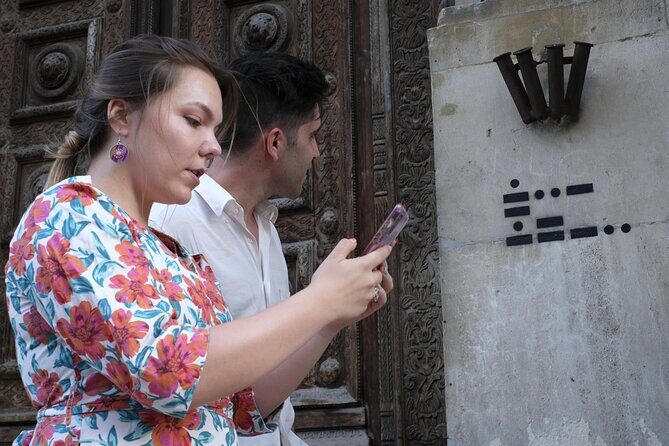
Your first big landmark cue is the Marine Building on Burrard Street—built in 1929–30 and credited here to Toronto’s short-lived Stimson Developers. It’s tied to commercial shipping interests and the Vancouver Merchants’ Exchange, and it’s described as Vancouver’s best surviving example of Art Deco.
What the quest asks you to do is simple: look around and answer the challenge that moves you to the next location. In a normal sightseeing situation, you might admire a façade for 10 seconds and keep going. In this game format, you’re pushed to notice architectural specifics, and that makes the neighborhood feel less like a blur and more like a place with layers.
Potential drawback at this stop?
If you’re coming in expecting ultra-clear instructions with no walking at all, you won’t get that. This is a “look carefully” game. If you skim the environment, you’ll miss the clue.
You can also read our reviews of more guided tours in Vancouver


Howe and Cordova: the customs warehouse story in 1911–1913
Next comes a heritage building at the corner of Howe and Cordova Streets. Construction began in 1911 and finished in 1913, designed by David Ewart, the Chief Architect for Public Works. The federal government built it as a warehouse linked to imported goods and it was used by Customs until 1958.
Again, the app’s method stays consistent: find the answer by looking closely, then use that to advance.
This stop is useful because it shifts your attention from “pretty building” to “what did government and trade actually need back then?” That warehouse/customs role matters in a city like Vancouver, where the port and shipping story is part of why downtown developed the way it did.
Waterfront Station: Canadian Pacific’s transcontinental gateway
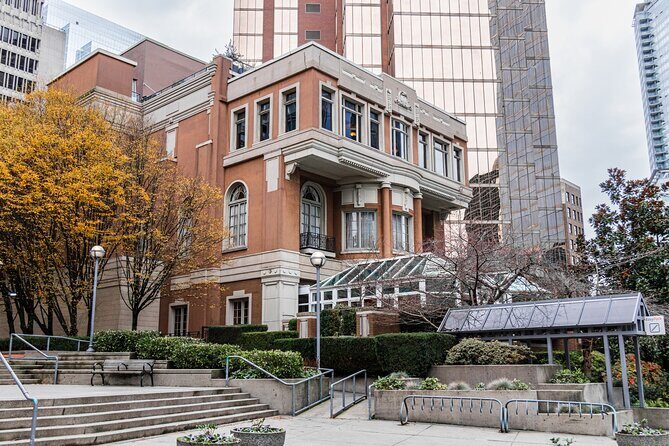
Then you’re at Waterfront Station, built by the Canadian Pacific Railway (CPR) and opened on August 1, 1914. The station served as the Pacific terminus for CPR transcontinental passenger trains to Montreal and Toronto. The current station is described as the third CPR station on the site.
This is a great checkpoint in the quest because railway stations are naturally story-heavy places. The app turns that into a scavenger hunt: use the setting to answer the clue, then move on.
One practical perk here: stations are easy landmarks for orientation. Even when you’re walking on your own, it’s comforting to have a well-known anchor point.
The steam-powered clock: built 1977, still part of the charm
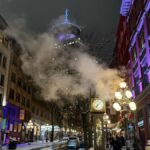
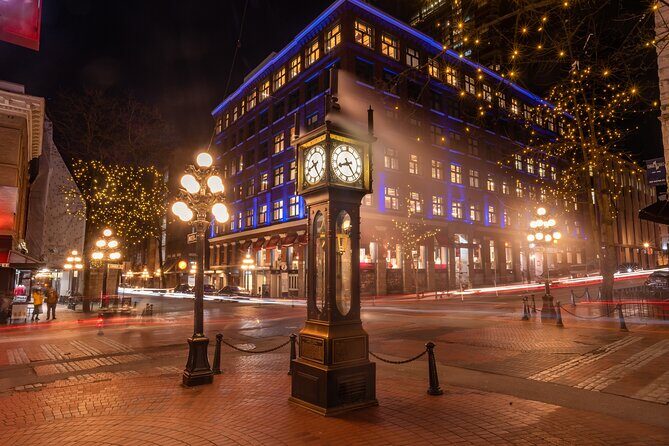
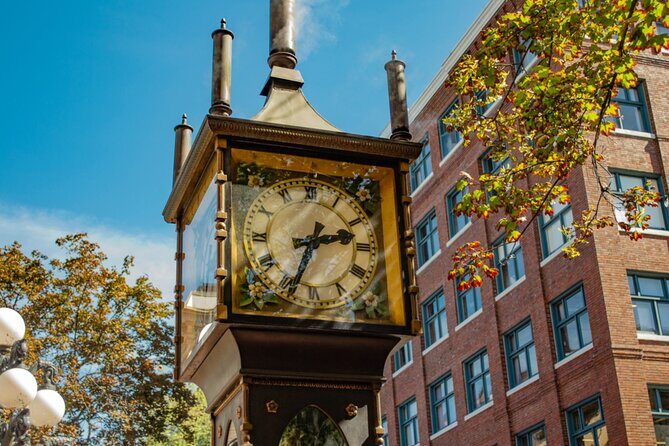
The next clue stop is a well-known antique-style clock, built in 1977, powered by steam and whistles to tell the time.
Even if clocks aren’t your thing, this is a smart game component. It’s an obvious landmark—hard to miss—and it adds a bit of character. It also gives you a moment where you can stop and reset, since you’re not constantly scanning facades for tiny details.
The Dominion Building: Beaux-Arts drama at street level
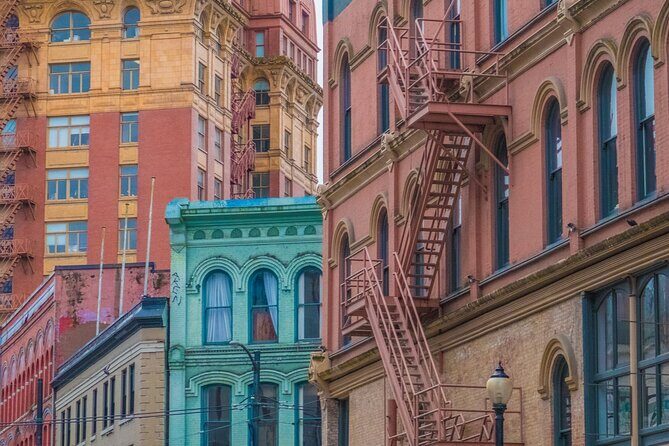
The Dominion building was built from 1908 to 1910 by J.S. Heyler. The quest frames it as one of Vancouver’s most colorful and charismatic heritage buildings, highlighting Beaux-Arts style, terracotta spandrels, and Corinthian columns at the front entrance.
This stop matters because the app encourages you to connect style with meaning. Beaux-Arts buildings often signal prestige and civic confidence. When you slow down here—long enough to look at the entry detailing—you get a better sense of how downtown once advertised success.
The only watch-out is also part of the charm: if you’re not in the mood to read or look closely, the clues might feel like work.
Sun Tower: architecture tied to Louis D. Taylor and the newspapers
The Sun Tower was built in 1911–1912. Its heritage value is described through distinctive landmark architecture and its association with Louis D. Taylor and the Vancouver World and Sun newspapers. It’s also presented as an example of downtown business district expansion to the city’s eastern fringe.
This is one of those stops where the “treasure hunt” label really earns its keep. The architecture plus the newspaper connection helps you understand what kinds of institutions helped shape daily life, not just the building itself.
When a clue requires you to look around, it often makes you notice who might have used that building and why it was important.
Sam Kee Building: Chinese community history at Pender and Carrall
Next is the Sam Kee Building at Pender and Carrall, built in 1913. It’s celebrated for architectural ingenuity and cultural significance to the Chinese community, plus history of its namesake.
This part of the route is valuable because it pushes past a narrow “old downtown = European-looking landmarks” idea. The quest frames the building as a key piece of Vancouver’s early citizens’ pioneering spirit and as part of the city’s broader cultural story.
If you want to understand Vancouver in more than one dimension, this is the kind of stop that helps.
Gassy Jack Deighton: Gastown’s origin story (and the reassessment)
Now you’re pulled into Gastown history via the statue of Gassy Jack Deighton. The quest describes him as a Vancouver saloon owner in the 1860s, and explains that Gastown is named for Deighton.
It also includes a more complicated note: his legacy has been re-evaluated in recent years, including his marriage to a 12-year-old Squamish girl, whose Squamish name is given as Quahail-ya and whose English name was Madeline Deighton.
This stop can shift how you read the neighborhood. Even if you’ve heard the “Gassy Jack = Gastown” idea before, the quest nudges you to face the full story, not just the catchy name.
Gaoler’s Mews: first jail history and the 1886 fire
In the heart of Gastown you’ll reach Gaoler’s Mews. The first building on this site dates to the mid-1800s and housed Vancouver’s first jail. After it burned down in Vancouver’s great fire of 1886, it was replaced by a brick fire hall.
This stop is the kind of local-history detail that makes a walking game feel more than entertainment. You’re standing where the city once held people—and also where recovery after disaster reshaped the built environment.
The Alibi: a heritage site ending at food, beer, and culture
The route finishes at what’s described as The Alibi—a heritage site erected over 100 years ago and positioned along the railyard near Vancouver’s trade and shipping ports. The app description frames it as a place for neighbors and community to share in food, fantastic beer, and culture.
This final stretch is useful because it gives you a clean landing point at the end of the game. After 14 challenges, a real-world destination for a drink or meal is a nice payoff.
The best way to play with friends (and avoid the common hiccups)
This is designed for groups to play together, and group discounts are mentioned. I also think it works especially well when the “team” is flexible—like one person running the phone while others answer questions out loud.
One consideration from real-world use: if multiple people are trying to download or run the game on separate phones at once, you can end up stuck. If you’re traveling with family and everyone wants their own device, it’s smart to decide who controls the app ahead of time.
If you do get stuck on a clue, the experience includes hints and an option to skip and keep moving. That keeps the walk from turning into a frustrating hour of staring at the same spot.
Who this treasure hunt is best for
I’d recommend this for you if:
- you like city walks but want a reason to look closely
- you’re traveling with friends or family and want something that’s not a formal guided tour
- you want an offline-capable activity
- you enjoy short, puzzle-based challenges more than lecture-style sightseeing
It may be less ideal if:
- you want a narration-heavy tour with a live guide (there isn’t one)
- you prefer guided, fixed “see this landmark then that landmark” pacing without problem-solving
- you’re counting on every clue being effortless from far away (you’ll need to look around)
Quick planning notes so your day stays smooth
- Duration is about 1 hour 30 minutes on average, but you can pause and resume if you stop for photos or a snack.
- The app language is English.
- The experience is listed as a private tour/activity, meaning only your group plays it.
- Service animals are allowed, and it’s near public transportation—helpful if you’re mixing it with other downtown stops.
- If you need flexibility with timing, the cancellation policy offers a full refund if you cancel at least 24 hours ahead.
Should you book this Vancouver Old Town Treasure Hunt?
If you want a low-cost, phone-powered way to see downtown Vancouver with purpose, I think this is an easy yes. For $7.20, you get a structured walk through major heritage stops, a storyline inspired by the Gold Rush, and offline functionality that helps you keep the game going outside Wi-Fi life.
I’d book it when you want “something fun and light” more than “a deep lecture,” and when you’re okay solving short clues by looking at buildings and details. If you expect a live guide to do the thinking for you, choose a conventional walking tour instead.
FAQ
What does the Vancouver Old Town Treasure Hunt cost?
It costs $7.20 per person.
How long does the self-guided walking game take?
The duration is listed as about 1 hour 30 minutes.
Is there a live tour guide included?
No. This is a self-guided experience, and it does not include a live tour guide.
Can I play it offline?
Yes, the tour is described as having offline functionality, which makes it easier to use when cell service is unreliable.
Where do I start and where does it end?
You start at 355 Burrard St, Vancouver and the experience ends at Maple Tree Square, 1 Water St, Vancouver.
What’s included in the quest?
You get a mobile access code to the quest, 14 puzzle-based challenges, storyline content inspired by Vancouver’s Gold Rush history, and the ability to pause and resume.
What landmarks are part of the route?
The game includes major stops such as the Marine Building, Waterfront Station, the steam-powered clock, the Dominion building, the Sun Tower, the Sam Kee Building, and Gastown stops including the Gassy Jack statue and Gaoler’s Mews, with a finish at The Alibi.