REVIEW · VANCOUVER
Sea to Sky Highway Self-Guided Driving Audio Tour
Book on Viator →Operated by Adventures with Action · Bookable on Viator
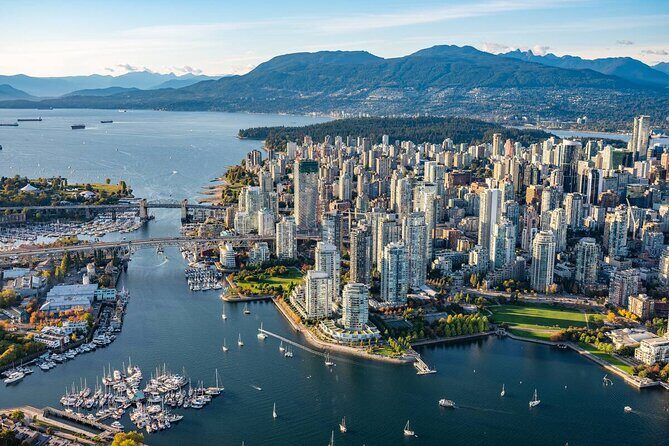
Sea to Sky turns your car into a storybook. You’ll follow GPS-triggered audio cues past places like Lost Lagoon and the Lions Gate Bridge, with offline playback and 90+ stories across about 75 miles.
What I like most is how easy it is to follow without feeling like you’re constantly reading directions, and how well the audio can play through your rental car speakers. I also appreciate that you can start, pause, and repeat with lifetime access, so it fits how you actually travel.
The main catch is time. If you try every detour and hike mentioned along the way (some take hours), the 2–3 hour drive can quickly turn into a half-day or longer, and some major attractions like the gondola are not included.
In This Review
- Key highlights you’ll actually feel on the drive
- Price and time: $16.99 per group is the real value
- Setting up: how the audio tour app works with your phone and car
- Stop-by-stop: Sea to Sky stories from Lost Lagoon to Whistler Creek
- Stop 1: Lost Lagoon (Stanley Park area)
- Crossing in front of Lions Gate Bridge
- Stop 2: Cypress Provincial Park detour option
- Stop 3: St. Mark’s Summit hike option
- Stop 4: Sea to Sky Highway and ancient trading footpaths
- Stop 5: Crystal Falls Road & Glendale Avenue
- Stop 6: Anvil Island myth and legend
- Stop 7: Watts Point Volcanic Centre
- Stop 8: Murrin Provincial Park for a lake break
- Stop 9: Sea to Sky Gondola viewpoint option
- Stop 10: Shannon Falls Provincial Park
- Stops 11–12: Stawamus Chief Trail and Stawamus Chief
- Stop 13: Eagle Run Vista Point detour
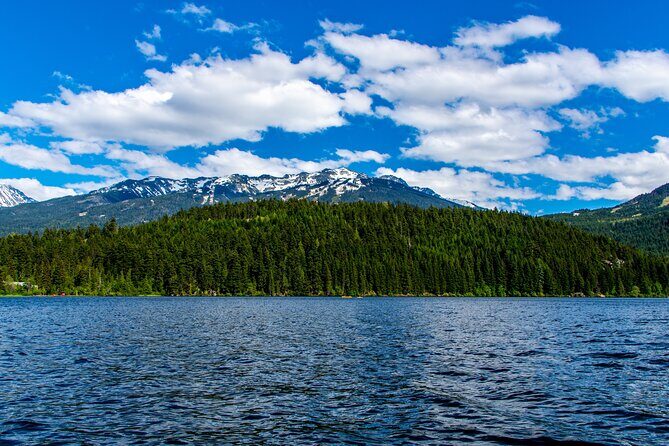
- Stop 14: Edith Lake and its group of lakes
- Stop 15: Alice Lake Provincial Park and the Four Lake Trail
- Stop 16: Tantalus lookout and the myth behind the name
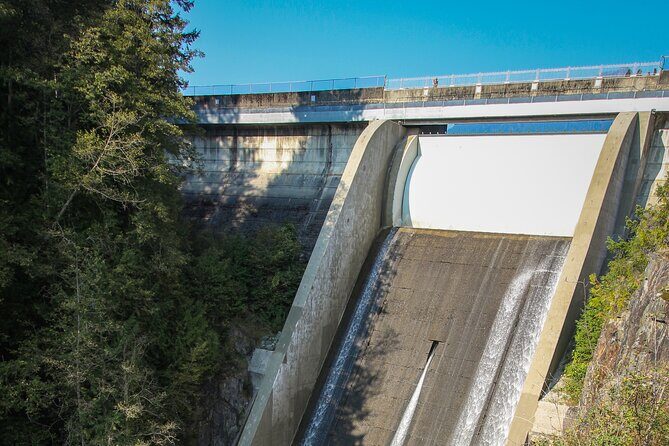
- Stop 17: Cheakamus River and the hydro dam story thread
- Stop 18: Rubble Creek Trailhead (all-day, brutal option)
- Stop 19: Cheakamus Hydroelectric Dam access option
- Stop 20: Daisy Lake name story
- Stop 21: Whistler Creek and how skiing scaled up
- Pacing your day: how to match the stops to your energy
- Should you book this Sea to Sky audio drive?
- FAQ
- How much does the Sea to Sky Highway self-guided audio tour cost?
- How long does the audio tour take to complete?
- Does it require cellular or Wi-Fi during the drive?
- Will the audio play automatically while I drive?
- Can I start and pause whenever I want?
- Where does the tour start and end?
- Are attraction tickets or reservations included?
- Is there free cancellation?
- Is the tour good for repeating on future trips?
Key highlights you’ll actually feel on the drive
- 90+ location-triggered stories over about 75 miles so you always have something to listen to.
- Offline maps and offline audio after download, which matters on roads with spotty reception.
- Hands-free playback that starts automatically when you reach the next story point.
- Priced per group (up to 4), which can be great value if you’re splitting with friends or family.
- Easy roadside stops plus optional real hikes if you want to trade convenience for effort.
Price and time: $16.99 per group is the real value
At $16.99 per group (up to 4), this is one of those deals that stays fair even if you’re traveling with a couple of people. If you normally pay per person for guided options, the per-car model can be the difference between skipping and doing it.
The route is designed to take about 2 to 3 hours to complete, which is a nice match for a morning or afternoon drive between Vancouver and Whistler. Just know the advertised time assumes you keep it moving and treat most stops as quick photo breaks. If you switch into hike mode at places like St. Mark’s Summit or Stawamus Chief, you’ll be adding hours.
Also, many stops are short, but that’s exactly why the audio works well. You can keep your windshield time steady and still feel like you explored.
You can also read our reviews of more guided tours in Vancouver

Setting up: how the audio tour app works with your phone and car

This is a self-guided driving experience, so no one meets you at the start. After booking, you’ll get instructions plus a password by email and text. The key step is to download the tour while you have strong Wi-Fi or cellular, because the experience is meant to work offline afterward.
Once you’re onsite, you open the Action’s Tour Guide App and start the matching version for your planned direction. Then you simply go to the first story point. After that, the audio is meant to play automatically as you reach the next cue.
For audio setup, you can connect your phone to your car through Bluetooth, USB, or AUX. If you do any walking detours, headphones can help because the roadside is not always quiet.
One more practical point: the tour window listed is 6:00 AM to 9:00 PM, which gives you lots of flexibility, but also tells you it’s best to plan around daylight if you want more than quick stops.
Stop-by-stop: Sea to Sky stories from Lost Lagoon to Whistler Creek
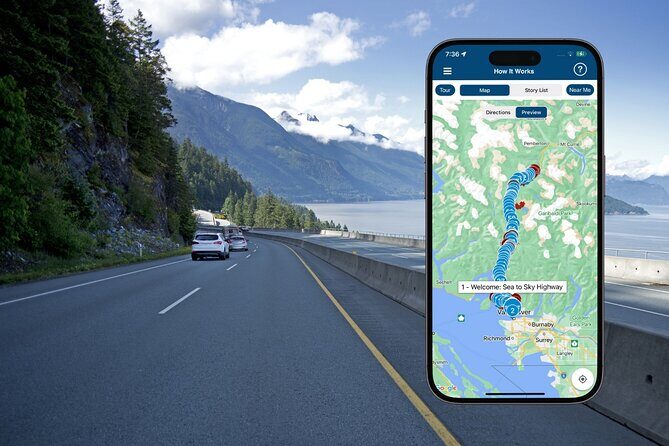
Below is what you’ll encounter as the drive unfolds. The audio is location-based, and each stop is designed to be a quick “pull over, listen, look, go” rhythm—unless you choose the longer hikes.
Stop 1: Lost Lagoon (Stanley Park area)
You start near Lost Lagoon in Stanley Park, a named landmark tied to the Indigenous Canadian poet Emily Pauline Johnson. It’s a great first story because it sets a tone: you’re not just driving for views, you’re learning the place behind the postcard.
If you only have a few minutes, this is still worth it because you’re paired with context before the bigger scenic stretches.
Crossing in front of Lions Gate Bridge
From there, the route lines up with the Lions Gate Bridge area. The narration points out the twin peaks ahead that give the bridge its name, and it even compares them to the twin lions of Trafalgar Square if you squint the right way.
This stop is more about orientation than sightseeing, and that’s useful early on. You’re getting bearings while you still have easy energy.
A few more Vancouver tours and experiences worth a look




Stop 2: Cypress Provincial Park detour option
Next up, you’ll have the option of a detour to Cypress Provincial Park. The one-way detour is about ten miles, so it’s not a casual turn-off, but the payoff is the kind of scenery that makes you glad you made the effort.
If you’re short on time, you can skip the detour and still keep the core drive on track.
Stop 3: St. Mark’s Summit hike option
Soon the road ends for a hike toward St. Mark’s Summit. The trail starts at Cypress Creek Lodge, and it’s about seven miles round trip, considered intermediate, with most people taking four to five hours.
This is where your “2–3 hour drive” math can change fast. If you’re not feeling a half-day hike, treat this as an optional adventure and stick to the drive.
Stop 4: Sea to Sky Highway and ancient trading footpaths
Now you’re on the Sea to Sky Highway, and the audio adds a layer many people miss. Beneath today’s route, the narration describes an older footpath used by the Squamish and Stó:lō Nations, connecting the two tribes for trading.
Even if you already love the drive, this story gives you a deeper reason to pay attention to the corridor itself.
Stop 5: Crystal Falls Road & Glendale Avenue
This is one of those “easy to miss” side highlights: Crystal Falls. The audio cues give you the choice—take the next exit for the waterfall, or continue straight if you’re keeping it moving.
If you like quick nature moments without a long walk, this is a solid stop to prioritize.
Stop 6: Anvil Island myth and legend
As you approach the Anvil Island area, the narration shares a story from the Squamish about Sínulhkay̓, a serpent tied to the island’s highest peak. Whether you treat the tale as mythology, history, or both, it’s memorable—and it helps the shoreline area feel less generic.
This stop is more listening than lingering. It’s a good reminder that not every amazing moment needs a ticket.
Stop 7: Watts Point Volcanic Centre
You’ll hear about the volcanic structure of the mountains and how Watts Point marks where volcanic material erupted. The audio also reassures you the last eruption is 90,000 years ago, so you can enjoy the scenery without worrying about dramatic rock behavior.
If you like geology or anything related to how the terrain formed, this is one of the more interesting “how it came to be” stops.
Stop 8: Murrin Provincial Park for a lake break
Murrin Provincial Park is built for a stretch of your legs. You can do an easy 1.5-mile lake stroll, or choose the Jurassic Ridge Trail, a roughly 2-mile loop that climbs about 700 feet and offers panoramic views from the top.
This is a good “choose your effort” stop. It’s also ideal if you want your drive to include at least one real walking moment.
Stop 9: Sea to Sky Gondola viewpoint option
Coming up is the Sea to Sky Gondola, described as rising nearly 1,000 meters above sea level to a lodge with a viewing platform. The narration gives it the “coolest stop” energy because the height changes how the whole region looks.
One important practical note: the audio tour itself does not include attraction passes. So factor in gondola ticket cost if you want the full experience.
Stop 10: Shannon Falls Provincial Park
Now you reach Shannon Falls Provincial Park, with an astonishing 1,000-foot waterfall. There’s a boardwalk around the base, and the hike to the falls is described as about 20 minutes.
This is the kind of stop that works for many fitness levels. If you want dramatic payoff without committing to a long ascent, this is a strong pick.
Stops 11–12: Stawamus Chief Trail and Stawamus Chief
These two points work together like a fork in the road.
Stop 11 is for expert hikers who can access the Stawamus Chief Trail, which climbs 2,300 feet to the top of The Chief. The audio suggests this is a serious trek—definitely not “on a whim.”
Stop 12 keeps it simpler for everyone else as you pass Stawamus Chief, described at over 2,300 feet above the Sound and linked to Ed Cooper, noted as the first person to summit and said to have taken four weeks.
If you’re not hiking, don’t rush past. Even a short pull-over for the mountain view can be rewarding here.
Stop 13: Eagle Run Vista Point detour
Eagle spotting is always fun, and this stop is designed for it. You’ll cross a bridge for Eagle Run Vista Point, with panoramic views and a detour that’s about 5 to 10 minutes.
Even if you don’t see an eagle, the viewpoint angle is likely why you’ll stop.
Stop 14: Edith Lake and its group of lakes
At Edith Lake, the narration describes a park dominated by four lakes: Alice, Edith, Fawn, and Stump. It also notes that most of the naming origins are lost, with Edith Lake having a specific story.
This is one of the stops where the audio can change how you look around. You’re not just seeing water; you’re learning why the names matter.
Stop 15: Alice Lake Provincial Park and the Four Lake Trail
If you want to stretch your legs, Alice Lake Provincial Park is a great move. The featured walk is the Four Lake Trail, described as an easy 4-mile loop that passes the four lakes in about under three hours.
This is a nice balance. It’s not the long summit-hike commitment, but it still gives you that “I walked somewhere today” feeling.
Stop 16: Tantalus lookout and the myth behind the name
Next comes Tantalus lookout, tied to Mount Tantalus, described as 2,608 meters from base to summit. The narration explains the name comes from the Greek mythological figure Tantalus.
This is a quick cultural detour, and it pairs well with the view. It also adds a human layer to what can otherwise feel like just big scenery.
Stop 17: Cheakamus River and the hydro dam story thread
You’ll drive alongside the Cheakamus River and the audio points you toward the Cheakamus Hydroelectric Dam. The dam is said to have been around since 1957, and it notes controversy in more recent times.
This is where the tour turns thoughtful. You’re reminded that scenic roads are also built in a living, evolving landscape with real impacts.
Stop 18: Rubble Creek Trailhead (all-day, brutal option)
An optional detour appears for Rubble Creek Trail, described as 15 miles and “brutally challenging,” leading to the top of Black Tusk Mountain. It’s called an all-day affair, so the advice here is basically don’t treat it like a quick walk.
If you’ve been keeping your drive light, skip this. If you’re a serious hiker with time and energy, it’s exactly the kind of challenge you’ll want.
Stop 19: Cheakamus Hydroelectric Dam access option
Right after the trailhead mention, the audio gives you another fork: turn right toward the Cheakamus Hydroelectric Dam, or keep going if you prefer staying on the main route.
The value here is choice. If you want the engineering story and the river context, stop. If not, you lose little by continuing.
Stop 20: Daisy Lake name story
You’ll pass Daisy Lake, named by Joseph William McKay. The narration notes that McKay was of Metis descent, and it explains Metis can refer to people from the historic Metis community of Manitoba or be used more generally for mixed European and Indigenous heritage.
This is one of those stops that turns a random body of water into a place tied to people and identity.
Stop 21: Whistler Creek and how skiing scaled up
Finally, you’re nearing Creekside Village at Whistler Creek, described as locally called the Creek. The audio contrasts the early days of Whistler Mountain skiing, when it had a single six-person gondola, with today’s scale of 79 lifts.
This ending lands well if you’ve been thinking about change and connection the whole way—nature, routes, communities, and how travel infrastructure evolves.
Pacing your day: how to match the stops to your energy
This tour works best when you decide in advance what kind of day you want.
If you want a simple scenic drive, treat most stops as quick photo and audio moments. The stop descriptions are built for that rhythm, and you’ll finish close to the 2–3 hour time range.
If you want a more active outing, pick one “bigger effort” stop and build around it. For example:
- Murrin Provincial Park for a lake hike plus maybe a viewpoint stop
- Shannon Falls for the boardwalk and short walk
- Alice Lake’s Four Lake Trail if you want an easy-to-moderate loop
The longer hikes are unforgettable, but they’re not a casual add-on. St. Mark’s Summit and Rubble Creek are both the kind of options that can swallow a whole morning or more.
Should you book this Sea to Sky audio drive?
Book it if you want:
- A self-guided way to learn the Sea to Sky corridor without joining a tour group
- A tour that’s priced per car and can be shared by up to four people
- A mix of quick pull-offs and optional walks, with audio that keeps you from zoning out on the straightaways
Skip it or rethink it if:
- You’re only interested in long, guided-style instruction, because this is a route you control
- You’re planning to do every hike and detour listed, since that can turn the experience into a much longer day than expected
- You don’t want to pay for any attractions, since the gondola is a separate ticketed experience
If you’re the kind of traveler who likes good storytelling, clean logistics, and the freedom to stop when you feel like it, I think this is an easy yes.
FAQ
How much does the Sea to Sky Highway self-guided audio tour cost?
It costs $16.99 per group, with room for up to 4 people.
How long does the audio tour take to complete?
It takes about 2 to 3 hours to complete.
Does it require cellular or Wi-Fi during the drive?
No. You need strong Wi-Fi or cellular to download the tour first, but after that it works offline.
Will the audio play automatically while I drive?
Yes. The stories are hands-free and play based on your location as you reach the next story point.
Can I start and pause whenever I want?
Yes. You can start anytime after you’re at the starting point, and you can pause and resume whenever you like.
Where does the tour start and end?
It starts and ends at Whistler Visitor Centre, 4230 Gateway Dr, Whistler, BC.
Are attraction tickets or reservations included?
No. Attraction passes, entry tickets, or reservations are not included.
Is there free cancellation?
Yes. You can cancel for a full refund up to 24 hours in advance.
Is the tour good for repeating on future trips?
Yes. It includes new, lifetime access with no expiry, so you can use it on future trips as many times as you want.