REVIEW · WHISTLER
Sea to Sky Highway: a Smartphone Audio Driving Tour
Book on Viator →Operated by Tripvia Tours · Bookable on Viator
You only need your car and a phone. This GPS audio driving tour turns the Vancouver-to-Whistler route into an easy, self-paced lesson with built-in stop cues. Expect history, place-name stories, and the kind of short “pull over here” moments that make a long drive feel more like a route with purpose.
What I really like is how much you can do without planning. The app plays automatically with a live GPS map, and you can linger at stops as long as you want since there are no group time constraints. Second, the value is strong: it’s priced per group (up to 15) and includes lifetime access to the app and data.
One thing to consider: the experience depends on your setup. You’ll want decent signal or Wi‑Fi to download at the start, and some people report occasional glitches or corny quizzes that they would rather skip.
In This Review
- Quick take: what’s the best part of this self-drive?
- Why this Sea to Sky Highway audio tour feels worth $8.22
- Data-free driving: the one logistics detail you should not skip
- From Vancouver to Whistler: using the narration to learn the route, not just see it
- Cypress Mountain and the Porteau Cove lookout: where the commentary makes you see more
- Howe Sound, fjords, and the place-name stories that turn scenery into meaning
- Britannia Mine Museum and Murrin Provincial Park: practical stops that don’t waste time
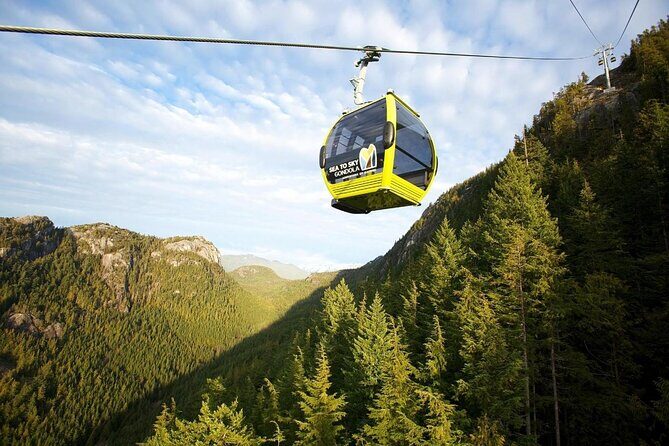
- Shannon Falls and the Sea to Sky Gondola area: the “stop now” payoff
- Stawamus Chief and the cliff-country feeling: more than a view
- Tantalus Lookout and a volcanic escarpment walk: when you want your legs involved
- Whistler Mountain, Alta Creek, and the Olympic snow detail that adds flavor
- The app experience: GPS audio works best when you let it
- Who this Sea to Sky audio driving tour fits best
- Should you book this audio tour?
- FAQ
- How long is the Sea to Sky Highway smartphone audio tour?
- Does the tour require data or a mobile signal while driving?
- Do I need internet to start the tour?
- Is this tour private?
- What language is the audio available in?
- How much is the tour?
- Can I use the tour on my own schedule?
- Do attraction tickets cost extra?
- Do I need to book more than once for a car?
- Is there a specific start and end location?
Quick take: what’s the best part of this self-drive?
- GPS-triggered narration that starts when you’re near each point, so you are not stuck guessing where the next stop is
- Data-free driving during the tour, as long as you’ve downloaded first
- Smart stop selection along the Sea to Sky corridor, including Shannon Falls and the Sea to Sky Gondola area vibes
- Flexible timing with no fixed schedule, so you can speed up, slow down, or add extra walking time
- A little quiz interactivity that some people love and some people find unnecessary
- Tiny price for a big route, especially if you’re splitting cost in a group
Why this Sea to Sky Highway audio tour feels worth $8.22
A narrated drive can go two ways. Either it’s expensive and you feel packed into someone else’s agenda, or it’s cheap and you worry it will be thin and generic. This one lands closer to the second, but with enough substance to justify the price.
For one, you’re not paying per person. The tour is $8.22 per group up to 15, and it only takes one booking per vehicle. That matters on a family road trip or a small group when everyone would otherwise end up paying for separate audio apps.
The best value is how the narration supports your real driving day. You’re not just “listening while you pass by.” You’re getting a reason to pull over, what to look for, and what the place-name and local history actually mean. A few of the higher-rated experiences also mention stopping at major hits like Shannon Falls and Sea to Sky Gondola views, then feeling like the drive finally had a story.
You can also read our reviews of more tours and experiences in Whistler.
Data-free driving: the one logistics detail you should not skip
Before you leave, plan for the download step. The tour notes say you need good mobile or Wi‑Fi connection for the initial download. After that, the tour is designed so that no signal or data is required during the experience.
In practice, this is where the audio tour can save you stress. You can park, walk, and drive without burning a data plan every mile. It’s also a good fit for rural stretches where cell coverage can be spotty.
That said, I’d treat the first try like a mini test run. Some users report a clunky download experience or issues after restarting the app, and a few mention GPS tracking getting off when navigating against directions on their car screen. If you do a quick download check before heading out, you reduce the odds of a messy start.
From Vancouver to Whistler: using the narration to learn the route, not just see it
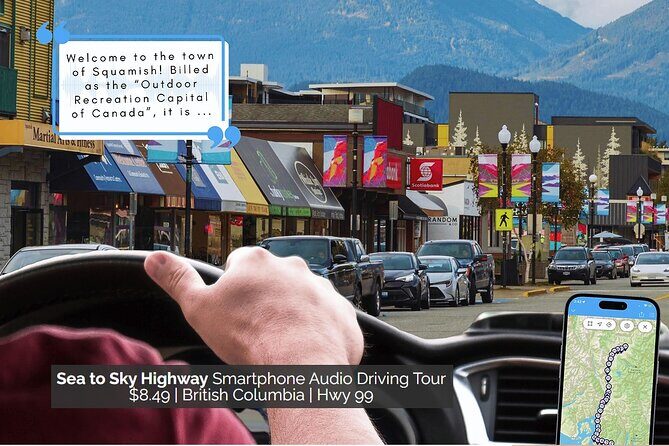
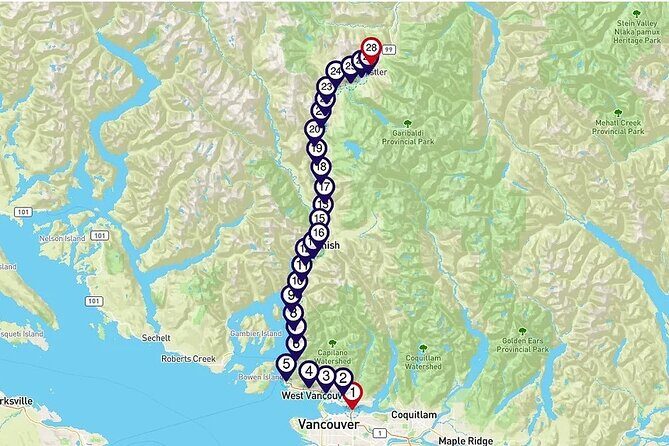
The tour starts with a straightforward driving setup: head north on Highway 1 over the Ironworkers Memorial Bridge, then merge onto Highway 99 all the way toward Whistler. If you’ve never done this drive, this simple map-based approach is helpful. You’re likely to keep your eyes on the road, yet still get guided cues for the “why stop here” moments.
As you roll through the North Shore area, the narration gives you useful framing. It explains that “Northshore” points to districts like West Vancouver and North Vancouver and the surrounding North Shore Mountains. It’s the kind of basic geographic context that makes later viewpoints feel more connected, not random pull-offs.
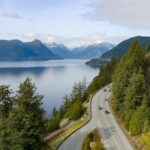
Then it shifts to water: you’re reminded that the long body of water you’re seeing is an arm of the Salish Sea, and you learn how the Georgia Strait separates Vancouver Island from the mainland. If you’ve ever driven this corridor and wondered what you were looking at, this kind of quick “name plus simple geography” is exactly what a driving audio tour should do.
Cypress Mountain and the Porteau Cove lookout: where the commentary makes you see more
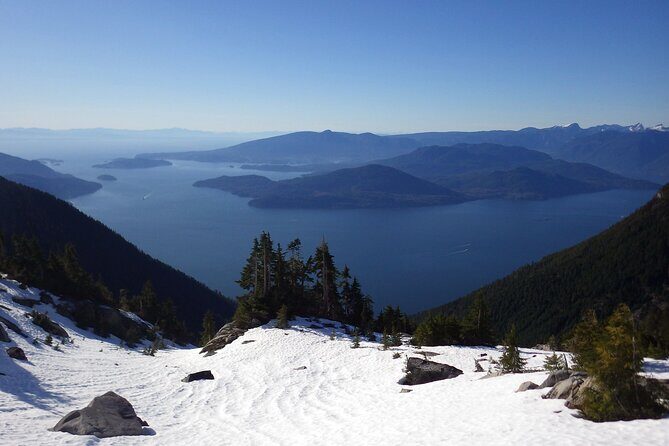
One of the early wins is how the tour treats viewpoints like learning checkpoints. The narration explains how the name Cypress Mountain came to be, and it points you toward Cypress Provincial Park trails if you have time. It even mentions trail systems like parts of the Baden Powell Trail and the Howe Sound Crest Trail—not as a full hiking plan, but as ideas if you want to stretch your legs on a clear day.
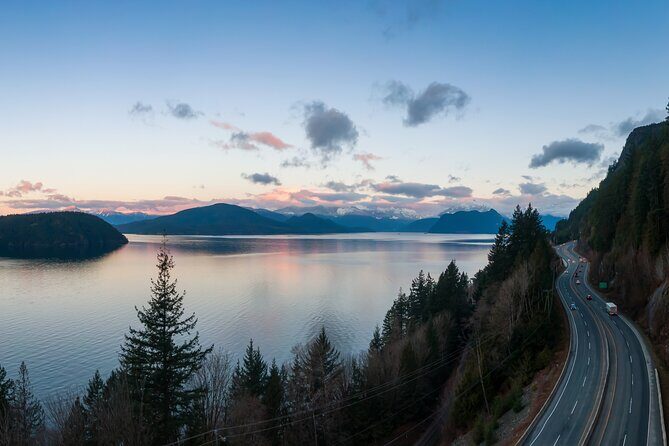
Then you get one of the best practical suggestions on the route: a quick stop at the Porteau Cove Road Lookout. Even if you only have a few minutes, a bird’s-eye view cue is often what turns a “drive-by” into something you remember.
This is also where the audio format shines. If you try to read signs while driving, you will miss details. With audio, you can park, listen, and then look. That rhythm makes the whole corridor feel more intentional.
Howe Sound, fjords, and the place-name stories that turn scenery into meaning
As you keep traveling along Highway 99, the tour leans into local context. It tells you about the Lions Bay Volunteer Search and Rescue Team, formed after landslides in the early 1980s. That kind of story doesn’t just add trivia. It adds a “why this place is taken seriously” layer, which helps you understand the region beyond scenery.
Next comes the maritime storytelling: you can hear how Anvil Island got its name, tied to Captain George Vancouver’s journal entry on June 14, 1792. Then the narration tackles Howe Sound and even breaks down the difference between fjord, sound, and bight.
If you like place names, this section is a payoff. People who are less into trivia may find parts of it slow, especially with quiz-style interludes. But even critical feedback points to the same core strength: the narration tries to connect what you’re seeing to what it means.



Britannia Mine Museum and Murrin Provincial Park: practical stops that don’t waste time
Two stops that make sense for real road-trippers are the roadside museum option and the park pit stop.
The audio points out a huge white building on the mountain with a Britannia Mine Museum sign. It’s framed as both a history lesson and a potential time-saver if you want one structured stop without spending hours planning. If you care about how a region developed around mining and industry, this is the kind of detour that adds weight to what you otherwise experience as pure scenery.
Then there’s Murrin Provincial Park, called out as a perfect pit stop with lots of parking and public washrooms. It also mentions the Murrin Park Loop Trail and a pictograph you can find along the route. This is the kind of stop that’s helpful even if you’re not a long-hike person. A short walk, a cultural artifact mention, and facilities make it easy to reset for the next stretch.
Shannon Falls and the Sea to Sky Gondola area: the “stop now” payoff

Some of the strongest praise centers on waterfall time. Shannon Falls is specifically highlighted, and one review notes that stopping at Shannon Falls and Brandywine Falls felt spectacular. Even if your final exact stops depend on the day and season, the narration is clearly aiming you toward the corridor’s best-known natural wow moments.
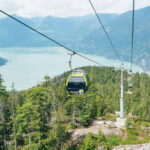
The tour also points you toward the Sea to Sky Gondola as part of what makes the drive special. That matters because gondola stops can be hit-or-miss if you don’t plan around them. Here, audio cues help you notice what you are passing, and then decide if you want to allocate time for a viewpoint ride or a walk.
If you’re trying to build a day that is mostly driving but still has “wow,” this is your section. Pull over, listen to the short context, then decide how long to stay.
Stawamus Chief and the cliff-country feeling: more than a view
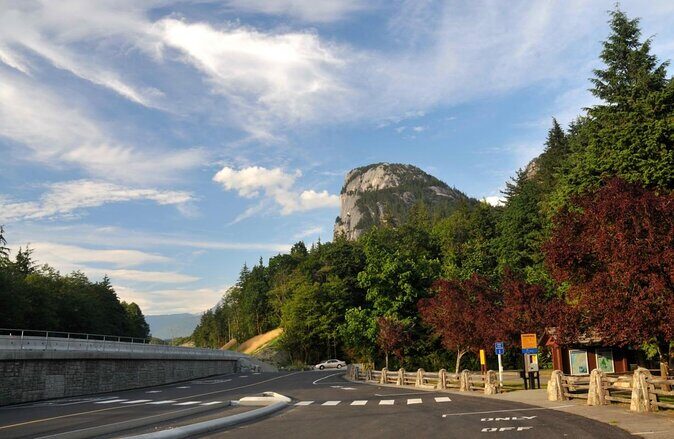
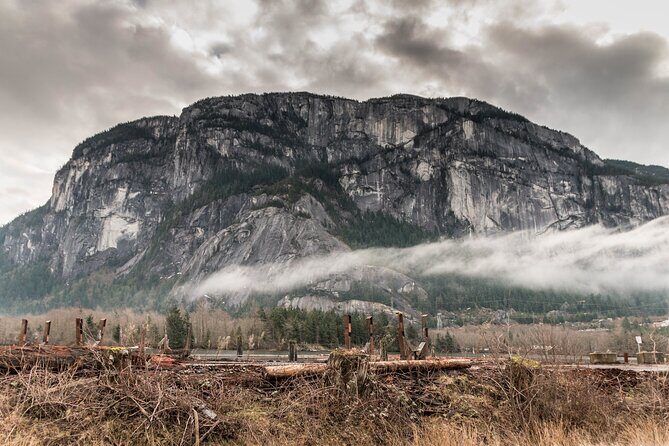
After waterfalls, the narration steers toward rock and scale, especially Stawamus Chief Mountain. It explains what the formation is and how it got its name, then frames the broader area as an outdoor recreation stronghold. You’re told it has a reputation as the Outdoor Recreation Capital of Canada, along with a bit of historical context.
This is where I think the audio tour does something subtle but valuable: it helps you understand why hikers and outdoor fans come back again and again. You’re not just looking at a famous face of granite. You’re learning the identity of the place.
You also get other environmental and viewpoint cues, including a section tied to wintering bald eagles in North America. That’s the kind of detail that can make your drive feel less like you’re just moving through Canada and more like you’re learning the region’s rhythm.
Tantalus Lookout and a volcanic escarpment walk: when you want your legs involved
Not all stops require a long hike, but the tour gives you two “choice” style opportunities that feel worth it.
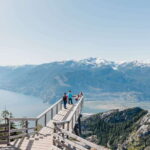
One is Tantalus Lookout, framed as another amazing viewpoint where you can check out the mountains. The other is a natural feature paired with a short 15-minute walk to a viewing platform perched on the edge of a volcanic escarpment.
Those walk-length cues are helpful. They help you decide in the moment. If you’ve been in the car for a while, a fifteen-minute stretch can be the perfect reset. If you’re short on time, you can treat it like a quick look-and-go.
Whistler Mountain, Alta Creek, and the Olympic snow detail that adds flavor
Once you’re nearing Whistler, the narration shifts from long-route context to local roots and identity.
The tour explains that Whistler Mountain had a different name before, and it explains why it is named what it is today. It also talks about how the games organizing committee worked to ensure snow for opening day, describing the effort as something that almost feels like its own Olympic event. If you’re visiting during or near a sports season, this kind of context can make the town feel less like a resort bubble.
Then you get Alta Creek, noted as technically named Alta Creek but commonly called something more fun and “sing-song.” It’s a small piece of local culture—exactly the sort of detail you’d never know from a map.
Finally, the tour rounds out with Whistler’s beginnings, tracing roots back to a British Royal Navy survey in the 1860s and how the area has been faring since. That ending matters because it keeps the drive from feeling like disconnected trivia. It closes with a sense of place: how Whistler became what it is.
The app experience: GPS audio works best when you let it
The concept is simple: audio points trigger with your location, and you follow along on a GPS map. Many people loved that it was GPS-based and knew when you were about to arrive at a location for narration.
But your mileage can vary based on phone model, car audio routing, and how your navigation app interacts with the tour app.
Here are the issues worth taking seriously before you hit play:
- Some users describe download problems that took too long or failed until later.
- A few mention the GPS not keeping them fully on track at times.
- Others say the narrator’s humor can be corny.
- Several complain that the quizzes or multiple-choice questions slow things down, and they feel it would be better to get facts with fewer interruptions.
- A few report audio volume challenges, especially when multiple people are listening in a car.
If you like interactive bits, the quizzes may keep you engaged. If you prefer quiet facts, treat the quizzes as optional flavor. Either way, the core win is that you’re not searching for your next stop description while driving.
A practical tip: before you drive, check that your phone volume and car sound system are set so the narration is clear for everyone in the car. The audio is timed to your proximity, so if you miss the start, you might end up scrambling after you’ve already passed the best viewing pull-off.
Who this Sea to Sky audio driving tour fits best
This tour fits best if you:
- Want a self-guided drive with flexibility rather than a structured bus tour
- Like learning facts while you travel, especially about place names, local history, and geography
- Are making the Vancouver-to-Whistler drive and want your stops to feel planned even without a formal itinerary
- Are traveling with a group and want a low per-vehicle cost
It may be less satisfying if you:
- Hate quiz-style interludes or find jokes distracting
- Expect a highly curated, step-by-step navigation replacement for your own GPS (the tour is supportive, not a full navigation system)
- Are prone to tech frustrations and would rather skip anything that requires downloads ahead of time
The sweet spot is a driver who enjoys stopping at scenic points and wants short, relevant context at exactly the right moment.
Should you book this audio tour?
Book it if you want a smart, low-cost way to add meaning to a famous route. The data-free narration after download, GPS-triggered timing, and strong stop suggestions like Shannon Falls and the Sea to Sky Gondola area make this a good match for most self-drives.
Skip it (or at least plan to manage expectations) if you know you dislike trivia quizzes, corny humor, or you have had trouble with GPS-driven audio on your phone before. In that case, you might still enjoy the drive, but you may not get the best version of the experience.
If you do book, do the one prep step that matters: download before you roll. Then drive, listen, and stop where the audio tells you why it’s worth your time.
FAQ
How long is the Sea to Sky Highway smartphone audio tour?
The duration is listed as about 1 to 2 hours, depending on how long you spend at the stops you choose.
Does the tour require data or a mobile signal while driving?
No. The tour notes say no signal or data is required during the tour, after the initial download.
Do I need internet to start the tour?
Yes. The tour requires good mobile or Wi‑Fi connection for the initial download.
Is this tour private?
Yes. It’s described as a private tour/activity, with only your group participating.
What language is the audio available in?
The tour is offered in English.
How much is the tour?
It’s $8.22 per group, with group size up to 15, per the tour summary.
Can I use the tour on my own schedule?
Yes. There are no time constraints listed, and the tour is yours to keep and enjoy anytime on the app.
Do attraction tickets cost extra?
Yes. Attraction tickets are not included.
Do I need to book more than once for a car?
No. The tour notes say only 1 tour booking is needed per vehicle.
Is there a specific start and end location?
Yes. It ends in a different location than where it starts, and the details are provided at booking.