REVIEW · MONTREAL
Irish Famine in Montreal Walking Tour
Book on Viator →Operated by Haunted Montreal · Bookable on Viator
Famine history hides in plain sight in Montreal. This Irish Famine in Montreal Walking Tour follows the story of refugees through real places you can stand on: the Old Port area, the Lachine Canal historic site, and the Black Rock gravesite. It’s run by Haunted Montreal and led in English, so you get clear context without needing to research first.
I like two things right away: it’s a focused 2-hour walk (not a half-day commitment), and the stops are free to enter, which makes the price feel like a real value at $20.23. One thing to keep in mind: it covers heavy ground fast, and if you want extra detail on every topic, you may wish the time on the subject had been longer.
In This Review
- Key Highlights to Know Before You Go
- Irish Famine History in Montreal, on Foot and on Purpose
- Price and What You Actually Get for $20.23
- Meeting at the Museum of Archaeology and History (and How the Route Feels)
- Stop 1: Old Port of Montreal and the Refugee Connection
- Stop 2: Lachine Canal National Historic Site and the Mass-Grave Location
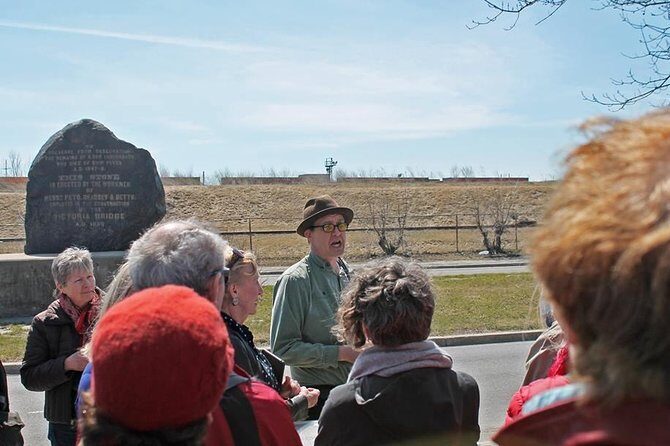
- Stop 3: The Montreal Irish Monument (Black Rock) and the 6,000+ Gravesite
- Why the 2-Hour Format Works (Especially for Busy Travelers)
- Group Size, Weather, and What to Wear
- Who Should Book This Tour (and Who Might Want a Different Option)
- Should You Book the Irish Famine in Montreal Walking Tour?
- FAQ
- How long is the Irish Famine in Montreal Walking Tour?
- Where does the tour start and end?
- Is the tour ticket mobile?
- Is the tour offered in English?
- Do I need to pay admission at the stops?
- What happens if the weather is bad?
Key Highlights to Know Before You Go
- Three meaningful Irish Famine locations in one tight route, each with a clear role in the story
- Haunted Montreal guides help you connect the dots at street level, not from a screen
- Exact on-the-ground pointing at the mass-grave area near the Lachine Canal
- Black Rock monument is the end point at the gravesite of over 6,000 Irish Famine refugees
- Small group feel with a cap of 40 travelers
Irish Famine History in Montreal, on Foot and on Purpose
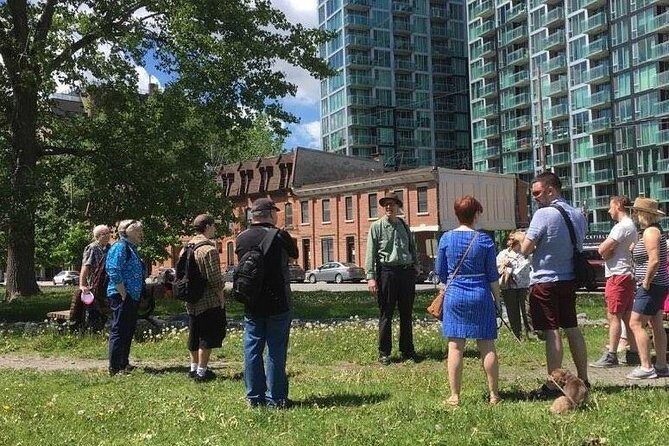
Montreal has layers. You can see them in old streets, in riverfront blocks, and in monuments you pass without stopping. This tour is built for that exact moment when you finally ask: what happened here, really?
What I appreciate is that it doesn’t treat the Irish Famine as just a distant European tragedy. The guide ties the story directly to Montreal—where people came through, what they faced, and how the city memorialized what happened. You’ll walk between three stops that each carry a different piece of the picture, so the history lands in a way that feels grounded instead of abstract.
And because it’s an English-language guided tour, you’re not stuck piecing together details from signs. The guide does the connecting, which is especially helpful on a topic this heavy and easy to misunderstand if you’re going in cold.
You can also read our reviews of more walking tours in Montreal



Price and What You Actually Get for $20.23
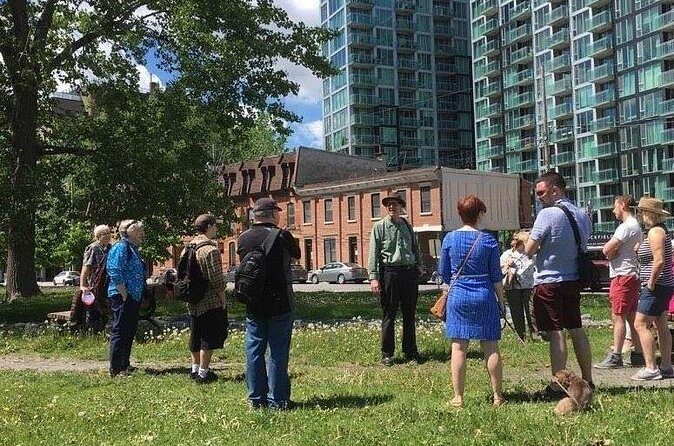
At $20.23 per person for about two hours, this is priced like an efficient city walk rather than a long museum day. The value comes from two parts:
First, the tour keeps costs low at the stops. Each main stop lists admission as free, so you’re not paying extra to enter buildings or ticketed sites as you go.
Second, you’re buying a guide’s time and context. The tour includes a “how this relates” explanation at the Old Port area, then turns to a more specific and serious marker near the Lachine Canal, and ends at the Black Rock gravesite. For many people, the real cost isn’t money—it’s time and attention. This format does both pretty well.
One practical heads-up: this tour is often booked ahead, with an average of 27 days in advance. If you’re traveling in peak season or you have limited afternoon options, I’d plan to reserve early so you aren’t gambling on last-minute availability.
Meeting at the Museum of Archaeology and History (and How the Route Feels)
You meet at the Montreal Museum of Archaeology and History, 350 Pl. Royale, Montreal, QC H2Y 3Y5. The tour starts at 2:00 pm and ends at the Montreal Irish Monument near Rue Bridge (the guide can help with directions at the end).
That meeting point matters. The museum area gives you a clear “we’re starting with context” vibe, and Pl. Royale is an easy area to orient yourself in. It also helps you arrive without doing a lot of legwork on your own, since the tour is designed as a guided walk from the start.
In terms of pace, the route is short and manageable for most people with at least moderate physical fitness. It’s not described as strenuous, but you should still expect walking time and standing time, especially at the last stop where you’ll want to take it in.
The group cap is 40 travelers, which is big enough that you’ll still feel part of a group, but small enough that the guide should be able to keep things moving.
Stop 1: Old Port of Montreal and the Refugee Connection
Your first stop is the Old Port of Montreal. This is where the tour begins to connect the Irish Famine refugees to the geography of the city.
What makes this stop worthwhile is that it’s not only about looking at a pretty waterfront area or historic buildings. The guide explains how the Old Port relates to people arriving and moving through Montreal during that period. In other words, you’re not just seeing “old” Montreal—you’re learning how Montreal worked as a place people could reach, depend on, or pass through.
This is also a good spot for orientation. After this introduction, you’ll have a clearer sense of why the later stops matter. If you’re the type who likes to understand the timeline, this first leg is your foundation.
Time-wise, the stop is about 30 minutes. That’s long enough for the guide to set context, but short enough that you won’t lose momentum before the more intense memorial sites.
Stop 2: Lachine Canal National Historic Site and the Mass-Grave Location
Next up: the Lieu Historique National du Canal-de-Lachine near the Lachine Canal. Here, the tour brings you to a location tied to some of the darkest consequences of the famine.
You’ll be shown the exact location of one of Montreal’s mass graves in the area. The fact that the guide points to a specific spot is important for how the experience works. Instead of treating this as a vague “somewhere near here” story, you’re given a concrete place tied to the history.
This stop lasts about 5 minutes, which can feel brief—until you remember what the tour is doing overall. The goal isn’t to turn the walk into a lecture. The guide gives you a clear marker, you take in what it means, and then you move on to the final gravesite.
Because the subject is heavy, I’d recommend leaning into the quiet moments here. If you’re with friends or family, it’s one of those stops where the right kind of silence helps the information stick.



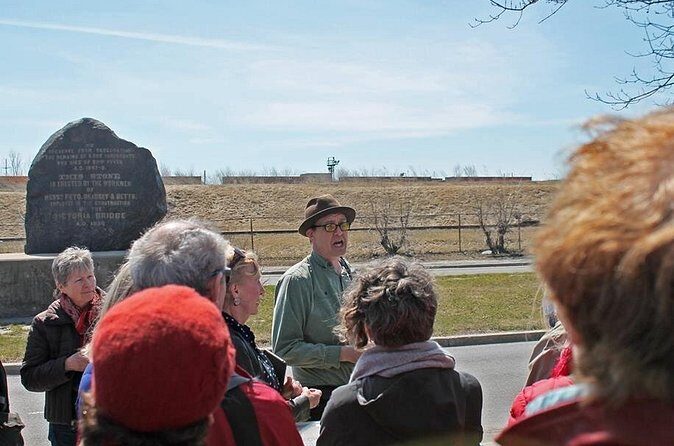
Stop 3: The Montreal Irish Monument (Black Rock) and the 6,000+ Gravesite
The last stop is the Montreal Irish Monument at the Black Rock. This is where the tour lands with its strongest emotional focus.
This monument is identified as the gravesite of over 6,000 Irish Famine refugees. That’s not a trivia fact—it’s the central weight of the story. Ending here shapes the whole tour. By the time you arrive, you’ve already been guided through how Montreal connected to refugee arrival and movement, so the gravesite feels like the logical end point rather than a random memorial you happen to visit.
Plan for about 10 minutes at the monument. Ten minutes may sound short, but for a site like this, time is best measured by attention, not by minutes. If you need a moment to process, take it. If you want to ask the guide a question, this is the natural place to do it.
This end point also means the tour finishes in an accessible public area, and the guide can give you directions afterward.
Why the 2-Hour Format Works (Especially for Busy Travelers)
A walking tour like this could easily turn into a long, exhausting march. Instead, it’s designed for a 2-hour experience that’s paced with intention: intro at the Old Port, pinpoint context at the Lachine Canal, and then a monument finish that ties everything together.
That short total time is a real plus if you:
- want history you can feel in the streets, not just read about
- prefer walking over sitting
- are fitting Montreal into a tight schedule
- are curious about Irish heritage in Montreal and want a guided starting point
It’s also helpful for first-time visitors. Even if you don’t know Montreal’s Irish history, the route gives you a practical way to learn it without “research fatigue.” You get a guided narrative with a clear beginning and a heavy ending.
The one drawback is that it’s still only a two-hour walk. If you’re the kind of traveler who wants deep detail on every nuance—specific dates, policies, or larger political context—you’ll probably want to do additional reading after the tour. But for many visitors, that’s also a benefit: you leave with the key places and the basic story, and you can follow up at your own pace.
Group Size, Weather, and What to Wear
This tour caps at 40 travelers, and it’s described as near public transportation. That matters because it keeps the experience more comfortable and makes it easier to join without a car.
You should also plan around weather. The experience requires good weather, and if it’s canceled due to poor weather, you’ll be offered a different date or a full refund. Since this is outdoors and you’ll be standing at memorial locations, a “mostly dry” day is the best bet.
For clothing, the data doesn’t specify footwear, but you should use common sense. Bring layers, wear comfortable shoes, and keep your plan simple: you’ll be walking enough that blister-proof footwear is not optional if you’re prone to foot pain.
Also note that the tour’s physical demands are listed as moderate, so if you have mobility limits, you may want to consider whether 2 hours of walking and standing works for you.
Who Should Book This Tour (and Who Might Want a Different Option)
I think this tour is best for people who like:
- real places with real stories
- guided explanations that make history understandable
- a structured route rather than wandering on your own
It’s also a strong fit if you care about Irish heritage in Montreal, and you want to see how the city marks what happened to Irish Famine refugees. The ending at Black Rock—linked to 6,000+ graves—is likely to be the moment that stays with you.
You might choose something else if you’re looking for a lighter, entertainment-style walk. This is focused on tragedy and memory, and it moves quickly through very serious subject matter. If you want a gentler pace or a broader range of Montreal culture stops, this might feel too concentrated.
Still, if you want one meaningful afternoon walk that gives you context you can’t easily pick up on your own, this fits the bill.
Should You Book the Irish Famine in Montreal Walking Tour?
Yes—if you want a guided walk that connects Irish Famine history to specific Montreal sites, and you’re okay with a serious tone. The value is strong: a reasonable price, roughly two hours, and no paid admission at the key stops. Ending at the Black Rock monument gives the whole route a clear emotional and historical anchor.
I’d book especially if:
- you like learning through place-based history
- you’re short on time but want real context
- you want a structured, English-guided route rather than self-guided guessing
Skip it or consider alternatives if you’re after a casual stroll or you need a lot more time to absorb and question the material. This tour gives you the core story and the key locations, then hands you the next steps.
FAQ
How long is the Irish Famine in Montreal Walking Tour?
It’s about 2 hours (approx.).
Where does the tour start and end?
You start at Montreal Museum of Archaeology and History, 350 Pl. Royale. The tour ends at the Montreal Irish Monument near Rue Bridge.
Is the tour ticket mobile?
Yes, you get a mobile ticket.
Is the tour offered in English?
The tour is offered in English.
Do I need to pay admission at the stops?
No. The tour lists free admission for the main stops.
What happens if the weather is bad?
The experience requires good weather. If it’s canceled due to poor weather, you’ll be offered a different date or a full refund.