REVIEW · CANMORE
The Sights of Canmore: a Smartphone Audio Walking Tour
Book on Viator →Operated by Tripvia Tours · Bookable on Viator
Canmore history comes with a GPS trail. This smartphone audio walk uses a live map and automatically plays the guide when you’re close, plus it layers in a location-based trivia game so you stay engaged while you wander.
I like how the route nudges you toward real Canmore landmarks, from coal-mining-era spots to the town’s Big Head connection. One thing to plan for: this is phone-first, so you’ll want your device charged and the tour downloaded for your group size before you start.
In This Review
- Key highlights before you download
- How the GPS audio tour actually works in the real world
- Why Canmore fits an app walking tour so well
- The walking rhythm: distance, timing, and where you’ll naturally slow down
- Stop-by-stop: the story the route tells you
- Stop 1: Three Sisters Gallery and the coal-mining setup
- Stop 2: Railway Avenue and the railway impact
- Stop 3: The British red telephone box corner
- Stop 4 and 5: Black bear and grizzly bear sculptures
- Stop 6: Mountain viewpoints and how names get assigned
- Stop 7: An inukshuk with meaning
- Stop 8: The coal mining cars monument
- Stop 9: Policeman’s Creek Boardwalk and the Bow River area
- Stop 10: Mount Rundle view
- Stop 11: Isabelle Dube mural and the tragic story
- Stop 12: Canmore Museum and Geoscience Center (optional admission)
- Stop 13: Friendship Park and the Japan connection
- Stop 14-16: Main Street, the Canmore Inn, and the Miners’ Union Hall
- Stop 17: Centennial Park and the Stan Rogers stage
- Stop 18-19: The church name mystery and the NWMP Barracks
- Stop 20: Big Head Sculpture and the Canmore name
- Price and value: what $8.22 buys you
- The practical “bring this” checklist (so it doesn’t annoy you)
- Who should book this Canmore smartphone walk?
- Should you book the Sights of Canmore smartphone audio tour?
- FAQ
- How long is the Sights of Canmore smartphone audio walking tour?
- How much does it cost?
- Where does the tour start and end?
- Do I need cell service during the tour?
- Is the tour available in English?
- Can I start and stop whenever I want?
- Is a ticket included for attractions like the museum?
- Is there a trivia game?
- Is this tour private?
- Are service animals allowed?
Key highlights before you download

- Live GPS guidance with automatic audio as you move from stop to stop
- Trivia questions at each point (optional, but fun)
- Coal mining anchors like the coal mining cars monument and miner-focused sites
- Wildlife sculptures explained with quick notes on black bears vs grizzlies
- Big Head Sculpture ties to Canmore’s name for a memorable ending
- A mostly quick pace with short stops and a couple longer “linger here” moments
How the GPS audio tour actually works in the real world
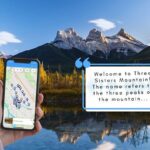
This isn’t a “read a plaque” kind of walk. You download the tour and then follow a route guided by live GPS. As you get near each stop, the audio guide starts on its own, so you don’t have to stop and manually trigger anything every few steps.
That’s a big deal for value. For the price, you’re basically getting a guided route without the pressure of a group meeting time, and without paying for a traditional guided tour. You can also stop and start as you like, which helps if you’re detouring for photos or you want to linger near a view.
The audio tour also includes a fun location-based trivia game. The questions are tied to each stop, and you’ll get a chance to answer right after the commentary plays. If you’d rather just listen and walk, you can skip the trivia. Either way, it keeps you from drifting into “just walking” mode.
You can also read our reviews of more walking tours in Canmore



Why Canmore fits an app walking tour so well

Canmore is the kind of place where a small set of landmarks can tell a lot of story. This route leans hard into the town’s themes: mining, railway influence, law-and-order days, local character, and the way people name mountains around here.
You’ll move through a blend of:
- public spaces (boardwalk sections, parks, and streets)
- outdoor sculptures and small landmarks
- historic buildings and memorials
- a museum stop you can add time to if you want more depth
Because the stops are spread across the town core and along familiar walking corridors, you get the feel of “seeing Canmore” without needing a bus, parking hunt, or a car loop.
The walking rhythm: distance, timing, and where you’ll naturally slow down

The tour is designed around a roughly 5 km return sightseeing loop. The full experience runs about 1 hour 30 minutes to 2 hours, depending on how closely you stick to the quick stops and how long you linger at the longer sections.
Most points are short (around 3 minutes each). A few are longer:
- A 10-minute stretch around Policeman’s Creek Boardwalk, where you can take in the Bow River area and related sights
- Another 10-minute window in Centennial Park, where viewpoints and a stage tied to events/festivals are part of the story
You’ll also have at least a couple of “pause-worthy” stops that are simply more interesting once you’re there—like mountain name views or sculpture moments—so even if the itinerary labels them as brief, you’ll probably add a minute or two.
A practical note: you start and end at the same spot on Railway Avenue (909A Railway Ave). That makes it easy to plan with other things in Canmore. If you’re pairing this with a meal or a museum visit, returning to the starting area is simple.
Stop-by-stop: the story the route tells you
Rather than feeling like separate trivia stops, the itinerary builds a theme as you go. Early on, it frames Canmore’s coal-mining days. Midway, it connects that past to transportation and town design. Then it shifts toward local identity—animals, mountain naming, community connections, and the Big Head story.
Stop 1: Three Sisters Gallery and the coal-mining setup
You begin at Three Sisters Gallery. This opening matters because it gives you context for what you’re about to see around town. You’ll get guided attention on places tied to Canmore’s coal mining era—plus the tour points you toward several “must-see” anchors that include Miner Union Hall and law-and-order sites.
If you like tours that explain why a place exists before you move on, this first stop is a good start. It also keeps the pacing friendly: you’re not dumping a long explanation right away—you’re getting a guided walk that sets up the next clicks in your audio route.




Stop 2: Railway Avenue and the railway impact
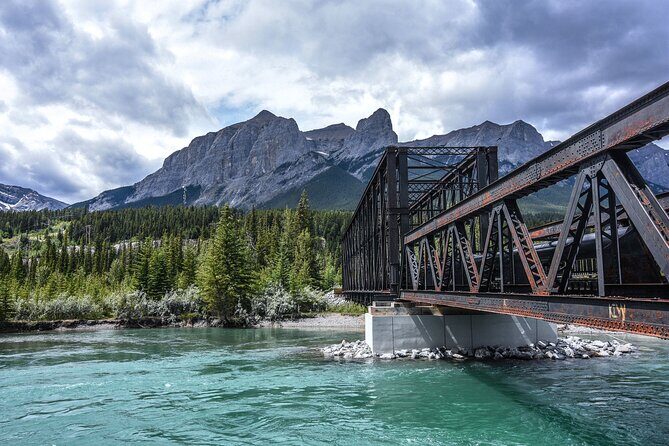
Crossing tracks is part of the experience here, and the narration uses that moment to talk about the Canadian Pacific Railway and how it shaped Canmore’s development.
I like this kind of stop because it turns something you might otherwise ignore—rails and crossings—into a story about growth. Even if you’re not a rail buff, the guide helps you connect transportation to the shape of a town.
Stop 3: The British red telephone box corner
At Sidney Street and Bow Valley Trail, you’ll get a prompt about the British red telephone box. It’s a small, familiar object, but the audio explains what’s going on with it.
This is exactly the sort of stop that works well for an app guide: you’re not just staring at a landmark. You get a reason to notice it in the first place.
Stop 4 and 5: Black bear and grizzly bear sculptures
Hospital Place and Bow Valley Trail brings you the black bear sculpture, and then Bow Valley Trail and 13 Street gives you the grizzly bear sculpture.
The tour doesn’t just point at the animals. It talks about black bears in Canmore and the Rocky Mountains, and then highlights differences between the two bear types. For me, this is one of the most useful “quick learning” segments because it’s simple, direct, and easy to remember later while you’re exploring the area.
Stop 6: Mountain viewpoints and how names get assigned
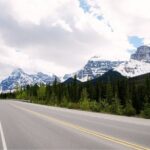
At Bow Valley Trail and 15 Street, the guide turns the northward mountain view into an educational stop. You’ll hear about how several mountain names came to be, including Princess Margaret Mountain, Squaw’s Tit, Mount Charles Stewart, Mount Lady MacDonald, and Mount Grotto.
This is the moment when the walk starts feeling more like “Canmore 101.” You’re learning the names that show up everywhere, and you’re not stuck guessing what you’re looking at.
Stop 7: An inukshuk with meaning
At Bow Valley Trail and 17 Street, the guide points out a big inukshuk and explains what inukshuks are.
This kind of stop helps if you’re visiting with mixed interests—maybe one person loves wildlife and views, while another person likes culture and symbolism. The audio gives you a reason to treat the sculpture as more than decoration.
Stop 8: The coal mining cars monument
At Railway Avenue and Bow Valley Trail, you’ll reach the coal mining cars monument. The guide connects mining to Canmore’s early days and the role it played in the town’s growth.
If you remember only one theme from the walk, make it this: the town’s identity is tied to mining and the working world that came with it.
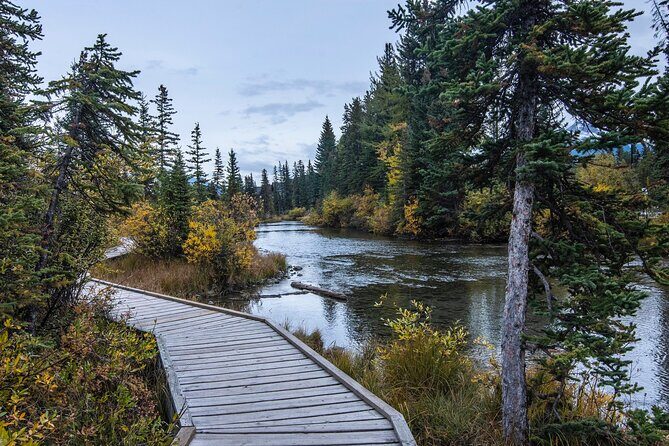
Stop 9: Policeman’s Creek Boardwalk and the Bow River area
Policeman’s Creek Boardwalk is one of the longer stops, around 10 minutes. The audio points you toward Bow River, the Canmore Nordic Centre, and festivals/events tied to the area.
This is a good place to slow down. Even if you’re moving quickly through other stops, you’ll likely want a couple extra minutes here for the boardwalk walk itself and the view angles.
Stop 10: Mount Rundle view
At 10 Street and 6 Avenue, you’re guided to a view of Mount Rundle, plus you get the key information the tour has about the mountain.
Views are common in this part of Alberta, but the difference here is that you get names and background while you look. That makes the scenery more satisfying.
Stop 11: Isabelle Dube mural and the tragic story
At 719 10 St, the audio introduces a mural of Isabelle Dube and explains the tragic story behind it.
This is a heavier stop than the sculptures and views. If you prefer your walks to stay light, you might treat this as a brief pause. If you like understanding the human stories behind places, it adds depth without adding a long time commitment.
Stop 12: Canmore Museum and Geoscience Center (optional admission)
At the Canmore Museum and Geoscience Center, you’ll see a facility with over 10,000 artifacts and a history of welcoming visitors since 1984.
Important: the museum admission itself is not included. So think of this as a “visit the museum if you want to” moment. If you’re short on time, you can still enjoy the exterior stop and move on. If you have energy, this is your chance to go beyond the street-level storytelling.
Stop 13: Friendship Park and the Japan connection
Friendship Park includes a cultural connection between Canmore and the Japanese city of Higashikawa.
This stop gives the tour a broader feel. It’s not only about the past and the mountains. It’s also about how Canmore builds relationships in the present.
Stop 14-16: Main Street, the Canmore Inn, and the Miners’ Union Hall
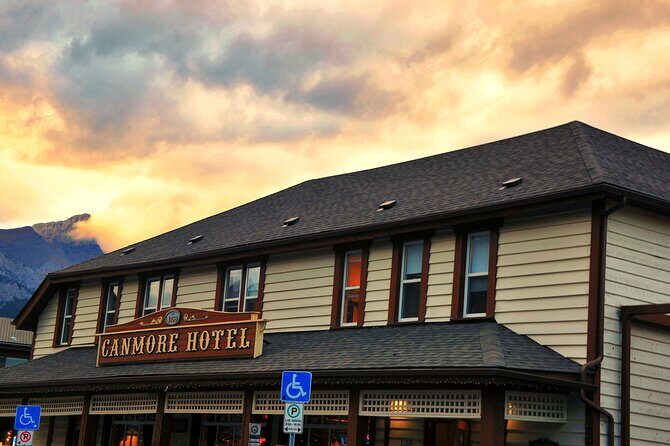
On Main Street (8 Avenue & 6 Street), you’ll pass shops, restaurants, and galleries that make up daily life in town. Then at Canmore Inn & Suites, the guide calls out a building built in 1890 by Count Eugene de Rambouville.
Finally, the Canmore Miners’ Union Hall gets a focused stop. The narration explains its importance and the often tense relationship between the town and miners.
This pair of stops—historic building plus the union hall—adds a sense of real-world complexity. It’s not just “mining happened.” It’s “mining shaped people, politics, and conflict.”
Stop 17: Centennial Park and the Stan Rogers stage
In Centennial Park, the tour hits three points: a view of the Three Sisters Mountains, the Stan Rogers stage, and a mention of annual events and festivals tied to the park.
This is one of the easiest places to enjoy “as a local might”—walk, look, then realize you’re in an event hub. Even if you visit outside festival season, the park still feels like it belongs in the town’s calendar.
Stop 18-19: The church name mystery and the NWMP Barracks
At Ralph Connor Memorial United Church Canmore, the audio points out one of the earliest Presbyterian churches built in Alberta and discusses a mystery behind its name.
Then at the NWMP Barracks, you learn how the barracks helped maintain law and order during rougher times. If you like the “how did small frontier towns keep order” side of history, this is a strong stop.
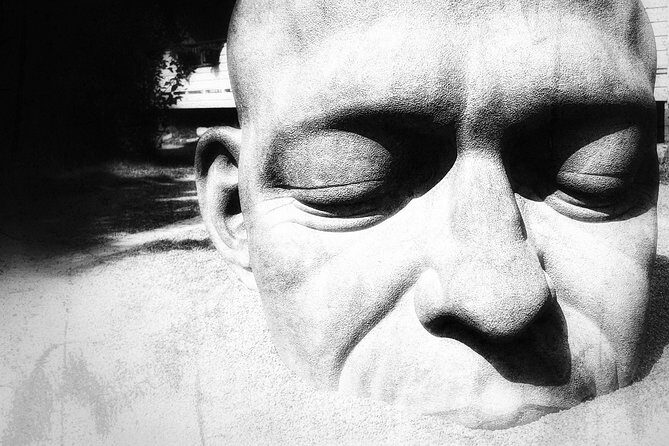
Stop 20: Big Head Sculpture and the Canmore name
You finish at the Big Head Sculpture, with the guide explaining how it connects to the name Canmore.
This ending works because it ties the whole walking route together: mining and town life gave Canmore its character, and the public art gives it a memorable identity you can point to later.
Price and value: what $8.22 buys you
At $8.22 per person, this tour is priced for people who want a guided-feeling walk without a big tour bill. You’re paying for:
- the GPS route and automatic audio commentary
- a structured set of stops across town
- optional trivia to keep you moving and paying attention
- a flexible format that you can reuse by starting and stopping where you want along the route
Most of the stops are free attractions (the tour notes “admission ticket free” at many points). A few places can involve extra admission, like the museum, but you’re not forced to pay at every stop. That makes the overall cost easier to manage.
Time value also helps. With an average 1.5–2 hour duration, it fits well on a travel day when you still want dinner plans, hikes, or other sightseeing.
The practical “bring this” checklist (so it doesn’t annoy you)
Because the tour is delivered on your smartphone, you’ll want to treat it like a tool, not an optional accessory.
Do this before you leave:
- Download the tour on Wi-Fi (the tour notes no signal required during the experience)
- Make sure you have enough battery for a 1.5–2 hour walk
- If you’re traveling as a group, note that the number of travelers selected is the number of devices that can download the tour
During the walk:
- Expect the guide to start automatically when you get close to each stop
- Use the GPS map to stay oriented, especially if you stop often for photos or to read quickly
If you’re the kind of person who likes control—choosing your pace and your stops—this format will feel comfortable.
Who should book this Canmore smartphone walk?

This is a great fit if you:
- like history and local stories but hate rigid group schedules
- want an affordable activity that feels guided
- prefer walking at your own speed
- enjoy small learning moments, like learning why a telephone box or sculpture matters
It may be less ideal if you:
- don’t want to rely on your phone while walking
- expect every stop to be a paid attraction you must enter (some are outside only, and some paid sites are not included)
Should you book the Sights of Canmore smartphone audio tour?
If you’re visiting Canmore and you want a budget-friendly way to understand the town, I’d book it. The GPS guidance keeps you moving, the stops cover the kind of landmarks you’ll actually remember (mining, wildlife sculptures, views, and Big Head), and the whole pace works well for a morning or afternoon.
If you want to add depth, pair it with the museum later. If you want to keep it light, you can treat it as a structured stroll and simply enjoy the narration. Either way, it’s a smart use of time in Canmore.
FAQ
How long is the Sights of Canmore smartphone audio walking tour?
The tour takes about 1 hour 30 minutes to 2 hours, depending on how you move between stops.
How much does it cost?
It costs $8.22 per person.
Where does the tour start and end?
It starts at 909A Railway Ave, Canmore, AB and ends back at the same meeting point.
Do I need cell service during the tour?
The tour notes that you can download on Wi-Fi before, and no signal is required during the tour.
Is the tour available in English?
Yes, it’s offered in English.
Can I start and stop whenever I want?
Yes. You can stop and start based on your own schedule, and you can start and stop anywhere along the route.
Is a ticket included for attractions like the museum?
No. Attraction tickets are not included. Some stops are marked as not included (like the Canmore Museum and Geoscience Center).
Is there a trivia game?
Yes. The tour includes a location-based trivia game at the stops, and it’s optional.
Is this tour private?
It’s private—only your group participates.
Are service animals allowed?
Yes, service animals are allowed.