REVIEW · TORONTO
Sports, Street Skateboarding, Economics, History & Culture
Book on Viator →Operated by Savant Tours · Bookable on Viator
A downtown walk that mixes sports and street culture feels rare. This tour threads Nathan Phillips Square, the PATH, film-fan Bay Street, and major-league sports stops into one 90-minute story of how Toronto works and plays.
I like the way it keeps moving but never feels rushed, with clear, question-friendly explanations from your guide, Duncan. I also like how the route is built around real places, not museum-style talking points.
What I especially appreciate is the mix: street skateboarding history and today’s scene sit next to hockey and NBA branding, plus a practical look at the Financial District and why it matters. You get context for what you’re seeing, not just where to stand for a photo.
One consideration: it’s weather-dependent and mostly walking, so if you’re not up for cold wind or rain, you’ll want to dress smart or pick a day with better conditions.
In This Review
- Key takeaways
- Why This 90-Minute Toronto Walk Feels Like Two Tours in One
- Meeting at Queen Street West and Ending at Raptors Way
- Nathan Phillips Square: More Than a Famous Toronto Sign
- Bay Street Corridor: Suits Filming Locations and the Film Industry Reality
- The PATH Portion: Pandemic Changes and Wayfinding You Can Feel
- Financial District Economics: Power in Numbers and People
- Street Skateboarding in Downtown Toronto: From Urban Architecture to Today’s Scene
- Brookfield Place: Architecture and the NHL Situation Room
- Legends Row and Raptors Way: When Sports Stars Become Street-Level Art
- Price and Value: Why $11.22 Can Beat a Bigger Ticket
- Who This Tour Fits Best (and Who Might Prefer Another Style)
- Should You Book This Toronto Sports and Street Culture Tour?
- FAQ
- How long is the tour?
- What does it cost?
- Where does the tour start and end?
- Is the tour in English?
- Is a mobile ticket provided?
- What’s included in the price?
- What’s not included?
- What happens if the weather is poor?
- How big are the groups?
Key takeaways
- Suits on Bay Street: how Toronto became a filming backdrop, plus the real-world pressures of production.
- The PATH under the city: pandemic-era changes and the navigation tech that keeps things flowing.
- Downtown street skateboarding: from early trick-film culture to what street skaters face today.
- Brookfield Place + NHL Situation Room: a behind-the-scenes angle on how the league operates locally.
- Legends Row and Raptors Way: sports trophies turned into public art and street naming.
Why This 90-Minute Toronto Walk Feels Like Two Tours in One
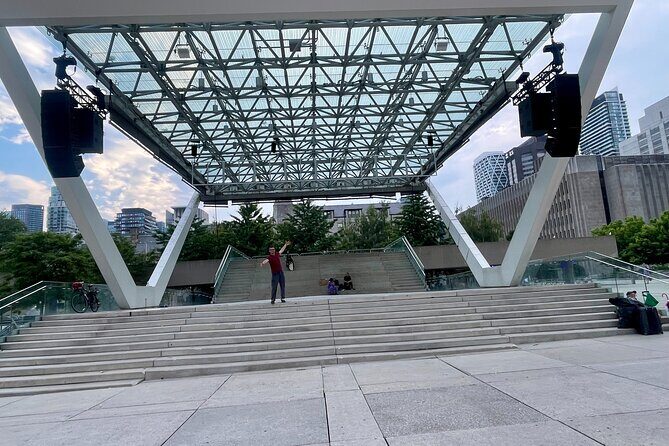
Toronto has a million ways to be “interesting,” but they’re usually separated. This one braids them together: sports culture, street skateboarding, economic power, and history you can point at. You’re not staring at a screen. You’re walking through the city’s props—squares, towers, plazas, and covered walkways—and the guide puts them into context.
I like that the tone stays practical. You’ll learn what matters about each area and why it exists, then connect it to everyday Toronto life. It’s also short enough that you can still pack in other plans the same day, without turning your day into a full-day march.
You can also read our reviews of more historical tours in Toronto



Meeting at Queen Street West and Ending at Raptors Way
The tour starts at 100 Queen St W, Toronto, and it ends at 19 The PATH – Maple Leaf Square, finishing at Legends Row on Raptors Way outside Scotiabank Arena. That means you’re moving from the core of downtown toward the sports district, and you end where you can easily continue exploring.
Group size is kept small, capped at 25 travelers, which helps the guide keep track of questions and pacing. You’ll also want to plan for a lot of street-level walking. Even when you step into covered sections like the PATH, it’s still a walking experience.
Good news for logistics: it’s near public transportation, and you get a mobile ticket. If you’re traveling with a service animal, this tour allows them too.
Nathan Phillips Square: More Than a Famous Toronto Sign
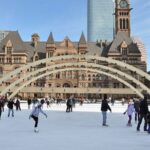
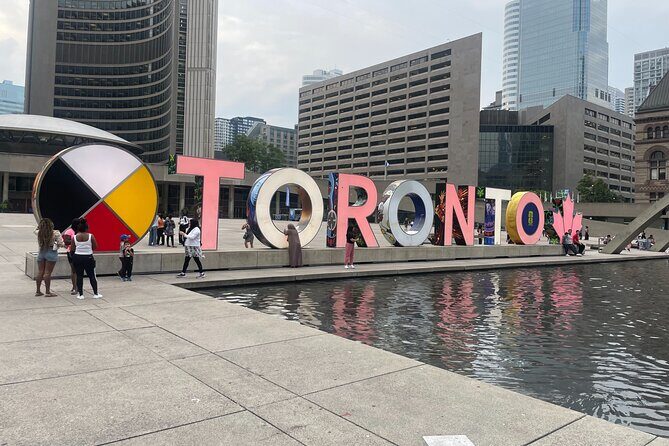
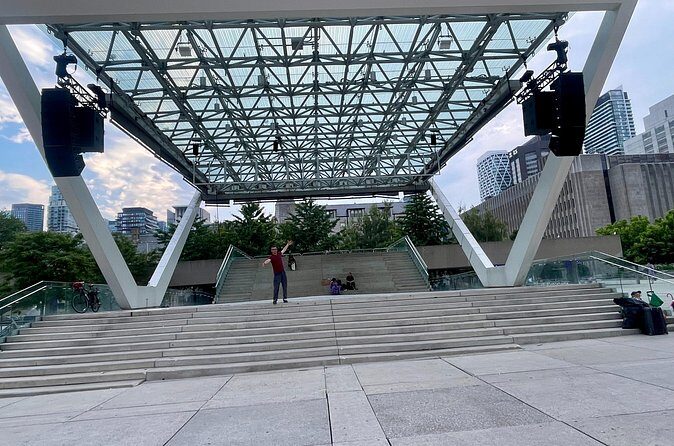
Nathan Phillips Square is the kind of place you know from photos—even if you’ve never stood in it. The tour frames it as a real civic stage: you’ll hear about the square’s history and its present-day role, including how it hosted one of the largest events in Canadian history.
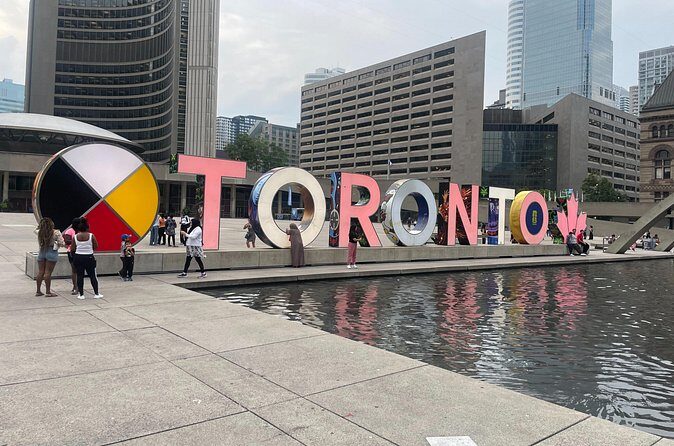
Then you’ll focus on a crowd favorite: the Toronto Sign by the ice rink. It’s one of those details that looks simple from a distance, but up close it’s clearly designed for celebration and city branding. The guide also points out nearby cultural additions that help explain how Toronto thinks about public space and public memory. One standout is the Reconciliation Garden next to Nathan Phillips Square, described in a way that makes the area feel more intentional than just scenic.
If you like your “big landmarks” with a human story attached, this is a strong start. You get your bearings fast, but not in a generic way.
Bay Street Corridor: Suits Filming Locations and the Film Industry Reality
Next comes Bay Street Corridor, where the tour shifts from city square energy to TV-and-film fame. You’ll learn about the Suits lobby location tied to Bay Street, including how Meghan Markle played a paralegal on the show and what the filming experience looks like for a real-world location.
The practical payoff here is understanding the friction behind the glamour. The guide talks about how productions deal with the realities of crowds, fans, and safety, and it also covers other film projects shot in the area. You’ll finish this stretch with a clearer sense of what it takes to film downtown and why Toronto’s film scene faces real challenges now.
It’s not just trivia. It helps you read Bay Street differently when you walk there on your own afterward—like you’re noticing the city as a working set, not only a shopping strip.
The PATH Portion: Pandemic Changes and Wayfinding You Can Feel
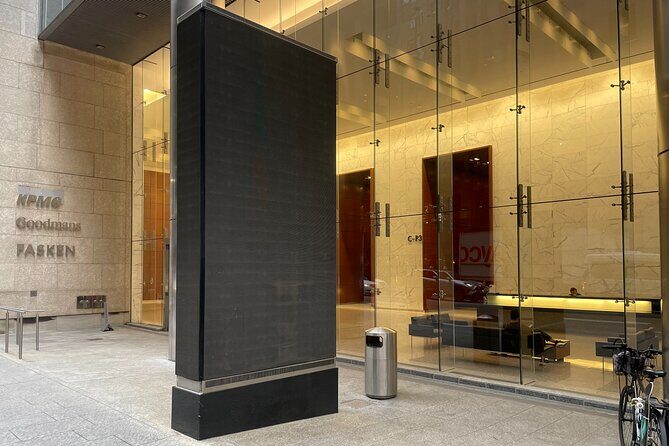
Toronto’s PATH is one of those features people either love or forget they’re in. Here, you get it explained like an urban system: the tour walks through a portion of the network and covers the history of the PATH, then the impact of its closure during the pandemic.
That matters because the PATH isn’t just a shortcut. It’s where people go when weather changes, schedules tighten, and office life pulls foot traffic underground. Once the closure happened and the city moved into hybrid work patterns, businesses had to adjust to less foot traffic. The guide’s framing helps you understand why some areas feel busier at certain hours, and quieter at others.
You’ll also learn about wayfinding technology used in the PATH to help people navigate. If you’ve ever wandered underground feeling like a confused extra in a movie, this part is genuinely useful. It’s the difference between walking through a maze and understanding how the system intends to guide you.






Financial District Economics: Power in Numbers and People
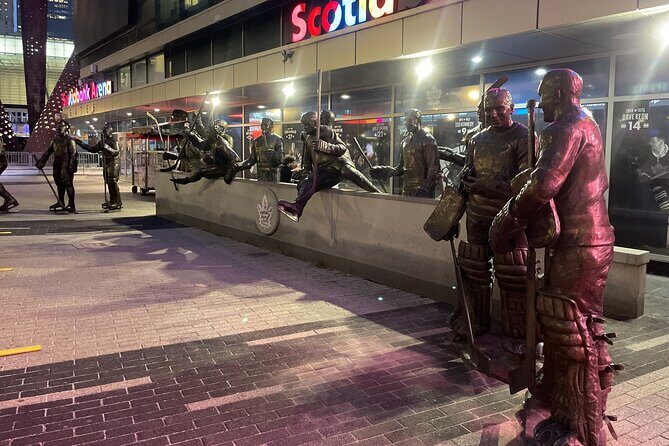
Then the tour steps into the Financial District, but it doesn’t treat it like an abstract map zone. You’ll hear about the history and evolution of Canada’s Financial District, and you’ll also get a sense of its importance to the Canadian economy.
The key detail here is the human scale: the tour covers the number of people employed in the district. That one fact tends to change your perception. Instead of thinking of the Financial District as just corporate towers and stone façades, you start picturing it as a workforce ecosystem that affects commuting, local services, and downtown energy.
If you like your economics translated into real streets and real employment, this is a good middle stop. It gives the day a structure: history → film → navigation → work → street culture.
Street Skateboarding in Downtown Toronto: From Urban Architecture to Today’s Scene
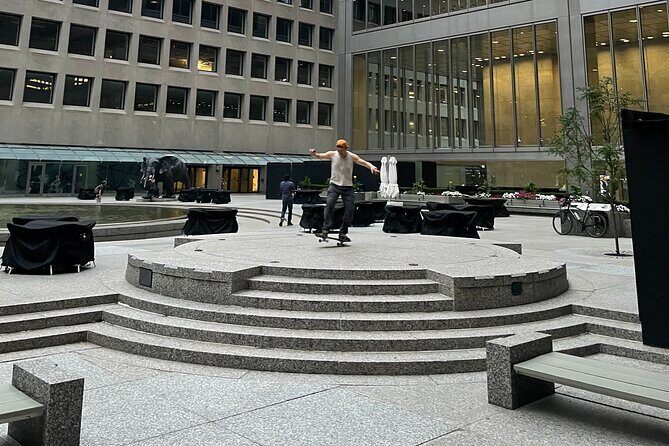
This is where the tour earns its personality. You’ll learn about the history and evolution of street skateboarding in downtown Toronto, including how professional skaters built careers by filming tricks on the urban architecture around them.
The guide then shifts from origins to the present. You’ll hear about the current climate for street skateboarding downtown—what skaters are dealing with now, and how the city’s shape and rules influence where and how people practice. This is the kind of context that’s helpful even if you’re not a skater, because you start noticing the “why” behind the city’s edges: smooth ledges, stair sets, rails, and the spaces people treat like a course.
I also appreciated the way the guide made it feel local rather than lecture-y. Skateboarding becomes a lens for understanding Toronto’s relationship with youth culture, public space, and creative reuse of city design.
Brookfield Place: Architecture and the NHL Situation Room
At Brookfield Place, you get a switch from street-level culture to corporate-modern architecture. The tour explains the area’s history and architecture, then adds a sports operations angle through the NHL Situation Room.
You’ll learn the NHL Situation Room’s role in the league, and that it’s located in the southwest tower at Brookfield Place. That detail is fun because it changes what you picture when you think of the NHL: less “games on ice,” more “systems and coordination” behind the scenes.
This stop works especially well if you like sports beyond fandom. It’s one thing to watch a game. It’s another to understand where information flows during the league’s day-to-day operations.
Legends Row and Raptors Way: When Sports Stars Become Street-Level Art
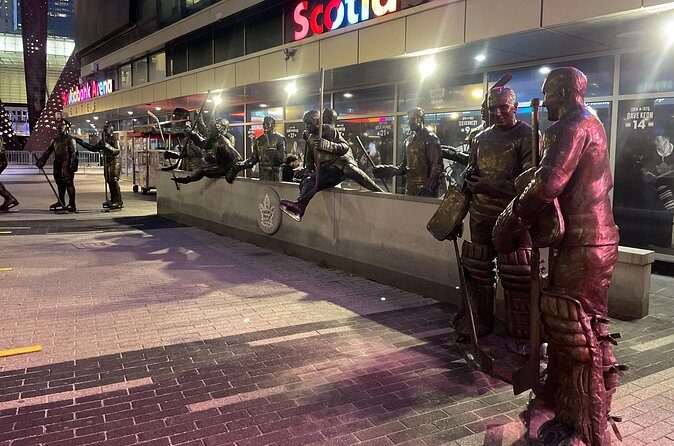
You end with Legends Row, a sculpture outside Scotiabank Arena featuring former Toronto Maple Leafs players. The tour explains the sculpture and its creator, tying hockey history directly to the public realm.
Then it expands into Raptors territory. You’ll hear about the Toronto Raptors acquiring Kawhi Leonard, winning the 2019 NBA Finals, and renaming Bremner Street to Raptors Way. The guide also talks about the challenge of attracting and signing top NBA talent as the only Canadian team in the league.
This ending lands because it’s not just big-team mythology. It’s city branding you can see in the street name and the sculpture lineup. You leave understanding how sports organizations shape real downtown space—sometimes proudly, sometimes with constraints you wouldn’t notice from a distance.
Price and Value: Why $11.22 Can Beat a Bigger Ticket
At $11.22 per person for roughly 1 hour 30 minutes, this tour is priced like a “do it when you’re in town” add-on. The value is that you’re paying for a guided route through multiple Toronto themes that normally cost more time (and often more money) to assemble yourself.
Here’s what you’re getting for the price:
- A tight downtown route that covers history, sports, film, and economics in one go.
- Clear explanations that help you connect what you see to why it exists.
- A practical included Google Map of Duncan’s Toronto recommendations for food, drink, and dessert.
- Travel advising at the end, so you can turn the walk into next-day plans.
One extra note: gratuity is not included, so plan to tip if you feel it’s deserved.
Also, it’s worth booking sooner rather than later. The tour data shows it’s commonly booked about 13 days in advance, which suggests it doesn’t always stay open for last-minute plans.
Who This Tour Fits Best (and Who Might Prefer Another Style)
This is ideal if you like:
- Walking tours with stories tied to sports, pop culture, and real city systems like the PATH.
- Street-level culture—especially if you’re interested in how Toronto’s built environment supports skateboarding.
- A guide who answers questions and connects dots between places.
It might be less ideal if you want a mostly indoor “sit and learn” experience, because this is a walking route. It also depends on good weather, so plan for that.
If you’re visiting Toronto for the first time, you’ll get a strong orientation across downtown. If you’re returning, you may still find it refreshing because it teaches you how to read familiar landmarks through different themes.
Should You Book This Toronto Sports and Street Culture Tour?
Yes, if you want a smart, short downtown experience that covers more than the typical highlight loop. The biggest reason to book is the mix: street skateboarding history, film-location context, economics in human terms, and major sports landmarks all in one route. It’s also backed by consistently high ratings and clear praise for the guide’s storytelling and local perspective.
If you’re the type who enjoys practical info and wants a quick plan for where to eat afterward, the included Google Map and end-of-tour advising make the deal even stronger.
Just make sure you can handle a walking tour in the weather that day. If you can, you’ll likely come away feeling like you learned how Toronto fits together, not just where to take photos.
FAQ
How long is the tour?
It runs for about 1 hour 30 minutes.
What does it cost?
The price is listed as $11.22 per person.
Where does the tour start and end?
It starts at 100 Queen St W, Toronto, ON M5H 2N2, and ends at 19 The PATH – Maple Leaf Square, Toronto, ON M5J 2J8, finishing at Legends Row on Raptors Way outside Scotiabank Arena.
Is the tour in English?
Yes, it’s offered in English.
Is a mobile ticket provided?
Yes, the tour includes a mobile ticket.
What’s included in the price?
You get a Google Map of Duncan’s Toronto recommendations (food, drink, and dessert) and travel advising at the end with planning and recommendations.
What’s not included?
Gratuity or tip is not included.
What happens if the weather is poor?
The experience requires good weather. If it’s canceled due to poor weather, you’ll be offered a different date or a full refund.
How big are the groups?
The tour has a maximum of 25 travelers.