REVIEW · SAINT JOHN
Historic Saint John Smartphone Audio Walking Tour
Book on Viator →Operated by Tripvia Tours · Bookable on Viator
One walk, two centuries of Saint John. This smartphone audio route uses live GPS to guide you past major port history, Loyalist arrivals, and key buildings tied to the 1877 fire—at your own pace.
I especially like the automatic audio that starts when you reach each stop, and I like how budget-friendly it is at $8.96 per person for roughly 1.5 to 2 hours of guided context.
One consideration: you’ll be on your feet through some hills, and you’ll need to bring your own smartphone (headphones are optional).
In This Review
- Key highlights worth planning for
- Starting at the Marco Polo Cruise Terminal: timing and tools
- How the GPS-triggered audio really works (and saves your data)
- From the port to Area 506 Container Village
- Furlong’s Liquor Store details you’ll never notice by accident
- The civic plaza, hidden warehouse remnants, and Bay of Fundy tides
- Loyalists, Fort La Tour, and the Great Fire of 1877
- Chipman Hill stories, Saint John Arts Centre, and Anglican landmarks
- Farmers’ market roof trick, King’s Square, and the Loyalist Burial Grounds
- Courts, the Fire House Museum, and the Imperial Theatre save story
- The Admiral Beatty Hotel and the Trinity Anglican Coat of Arms episode
- Banks, Domville Building policing tales, Police Museum, and Saint John High School
- Stoneleigh Terrace and the navigation lamp along the bay
- Value for $8.96 and who this walk fits best
- Should you book this Historic Saint John smartphone audio walk?
- FAQ
- FAQ
- Is the tour offered in English?
- How much does the Historic Saint John audio walking tour cost?
- How long should I plan for?
- Do I need mobile data during the walk?
- Do I need headphones?
- What device do I need?
- Where does the tour start?
- Is this a private tour?
- Is the route difficult to walk?
- Are service animals allowed?
Key highlights worth planning for

- Live GPS + a visible route helps you track where you are without guessing.
- Stop-by-stop audio plays automatically as you arrive at each point of interest.
- Low price for a long, story-led walk through Uptown and the waterfront area.
- Real place-based scenes: port trade, Loyalist exile, Fort La Tour, and the Great Fire of 1877.
- Design details you’d miss alone, like the farmers’ market roof and church/architecture clues.
Starting at the Marco Polo Cruise Terminal: timing and tools

Your walk begins at the Marco Polo Cruise Terminal at 111 Water St in Saint John, then you loop back to the same meeting point. This matters if you’re doing a day from a cruise or a short visit, because you’re not trying to coordinate a one-way transit back to your starting point.
The tour runs about 1 hour 30 minutes to 2 hours, depending on how long you pause for photos and reading the buildings up close. There’s no clock pressure, which I like for historic walking tours: Saint John rewards slow looking. The route also contains some hills, so pack accordingly—good walking shoes beat clever footwear every time.
You’ll want a smartphone or tablet for the mobile experience. The good news is the audio experience is offered in English, and the service runs across flexible dates with the tour available throughout the day (scheduled 12:00 AM to 11:30 PM daily).
You can also read our reviews of more walking tours in Saint John



How the GPS-triggered audio really works (and saves your data)
This isn’t a “download an app and pray” kind of tour. You’re told to download on WiFi before you start, and you don’t need signal during the walk. That’s a big deal in a place like downtown Saint John where coverage can vary from block to block.
When you’re ready, the tour uses a mobile ticket plus a live GPS map that shows your route and your location. As you reach each point of interest, the commentary plays automatically. Practically, that means you can concentrate on the streets and facades instead of constantly tapping menus.
Headphones aren’t included, but optional headphones are allowed. If you don’t have them, the audio will play from your device speaker too—just keep your volume sensible so you don’t start a street-side theater review.
From the port to Area 506 Container Village

Early on, the walk sets the tone with Saint John’s role as a major port in the Maritimes. You’ll see cargo ships and cruise liners pass through, and you’ll hear how centuries of trade and immigration shaped the city. This stop is a nice way to orient yourself: if you understand the port, a lot of the later stories about buildings and neighborhoods suddenly make sense.
Then you’ll move to the Area 506 Waterfront Container Village. What makes this stop fun is the reuse angle. Businesses are housed in repurposed shipping containers, so the setting feels modern while still tied to the waterfront world. You can browse and shop for art, crafts, and food, and you’ll also get a stop devoted to the Graffiti Alley murals—works by artists from around the world. Even if street art isn’t your main interest, it’s a change of pace from stone and brick and it makes the walk feel current.
Downside? If shopping and eating are your focus, it’s easy to lose time here. If you’re trying to stick to a tight visit window, plan to do this stop efficiently and keep moving.
Furlong’s Liquor Store details you’ll never notice by accident

One of the most memorable moments on the route is the Furlong’s Liquor Store area. You’ll pause outside (or near) the structure while you hear a special guest’s vision, connected to what the building’s design was meant to hint at—treasures within.
The story also highlights specific features: intricately carved marble columns and whimsical gargoyles. If you’ve ever walked past a landmark and thought, “How did I miss that?” this is your antidote. The audio gives you the reading glasses to look at details the average visitor might skate right over.
It’s also repeated on the route, which suggests it’s a key narrative stop. If you’re sensitive to repeated segments, you might want to be ready for a second explanation with slightly different emphasis.
The civic plaza, hidden warehouse remnants, and Bay of Fundy tides

Next you’ll step into a civic plaza that functions as a gathering place. The audio explains how it shifted from a commercial port and even a parking lot into something community-oriented. That transformation is more than a “nice improvement” story—it’s a reminder that public space in Saint John keeps getting reinvented as the city’s needs change.
Then you’ll get a second layer: remnants of mid-1800s warehouses and a strange history connection to the Bay of Fundy tides. Tides in this region are famously dramatic, and the tour uses that reality to explain how ships tried to moor and how water movement shaped what happened around the harbor.
If you enjoy the practical side of history—how geography and weather affect daily life—this section is a strong payoff. It also helps you understand why Saint John’s waterfront looks the way it does.
You can also read our reviews of more historical tours in Saint John

Loyalists, Fort La Tour, and the Great Fire of 1877
If you only remember one theme from Saint John, let it be displacement, survival, and rebuilding. The tour gives you the Loyalist arrival story in a clear sequence, including the pivotal moment in 1784 when thousands of Loyalist refugees reached Saint John after fleeing persecution during the American Revolution.
From there, you’ll hear the harrowing tale tied to Fort La Tour and Françoise Marie Jacqueline, known as The Lioness of La Tour. The audio frames her defense of the fort and her ultimate sacrifice in a personal way, including her story in her own words. It’s emotional without getting abstract—this is one of the stops where the audio format is doing real work for you.
Then comes the Great Fire of 1877. You’ll walk by brick and stone buildings that act like physical monuments to what burned and what survived. You’ll hear how the city rebuilt itself and made the area more fire-resistant afterward.
This is the kind of stop where taking a few minutes is worth it. When you see historic materials after learning why they exist, they stop being “old stuff” and start being evidence.
Chipman Hill stories, Saint John Arts Centre, and Anglican landmarks

As the route moves through Uptown, it connects streets to individual lives. You’ll pass the Chipman Hill Suites and hear about one of its first residents—a woman who defied social norms. Even if you don’t catch every detail while walking, that’s a helpful reminder: history here isn’t only about battles and disasters. It’s also about day-to-day people pushing boundaries.
You’ll then visit the Saint John Arts Centre, which the audio explains was originally built as a public library and is a strong example of French Beaux-Arts architecture. The lesson isn’t just “pretty building.” It’s how public institutions change form: library to arts center, and how civic buildings can stay relevant long after their original purpose.
After that, you’ll see Saint John’s Anglican Church, described as the oldest surviving stone church in the city. You’ll hear why it mattered to Loyalists and how it reflects community resilience and faith.
A little later, the tour includes a quiet street stop featuring a Federalist-style home with a secret connected to the American Revolution. You’ll learn about the family who built it and the clever architectural choices that helped it last. If you like architectural storytelling, this section rewards close attention. Look for what the building is doing structurally, not just what it looks like.
Farmers’ market roof trick, King’s Square, and the Loyalist Burial Grounds

Canada’s oldest continuously operated farmers’ market is part of the walk, and the audio gives you a practical visual clue: the inverted ship’s hull roof. That kind of detail is exactly why audio tours beat a self-guided “read one plaque” strategy. You get a reason for the design, not just a photo moment.
Next, you’ll head to King’s Square, a historic green space that once included public punishment and civic unrest. The tour points you toward monuments that carry secrets of sacrifice and honor. This stop feels like a tonal shift, because it asks you to hold two realities at once: a calm park today, and conflict in the same space long ago.
Then you’ll step into the Loyalist Burial Grounds. You’ll hear a story from a Loyalist who fled the American Revolution and how the burial ground evolved into a peaceful park. That transition—private sorrow to public remembrance—is a theme the tour comes back to more than once.
Courts, the Fire House Museum, and the Imperial Theatre save story
The walking route also leans into law and public life. You’ll see the Saint John County Court House and hear about infamous trials. If you’re used to thinking of old buildings as mainly decorative, these reminders hit differently. Courts tell you what a society argued about, punished, and tried to settle.
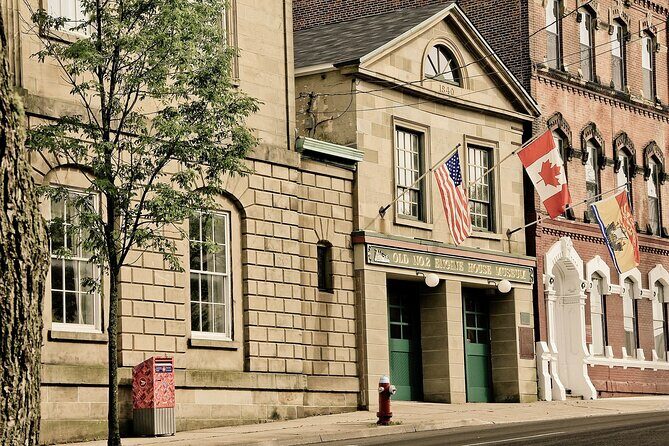
Next door is the Fire House Museum, said to have survived two of the city’s worst fires. In the same tour where you learn about the Great Fire’s impact, that survival detail becomes more than trivia—it’s another example of how the city’s architecture carries scars.
Then you’ll reach the Imperial Theatre, built in 1912. The audio explains it was nearly demolished, then restored to its original glory after being saved by a local taxi driver. It also covers its earlier uses as a vaudeville and film house. I like this stop because it’s a reminder that “culture buildings” are part of a city’s survival story too, not just its leisure.
The Admiral Beatty Hotel and the Trinity Anglican Coat of Arms episode
The route moves to the Admiral Beatty Hotel, formerly a luxury hotel with suites reserved for royalty. The audio also references notable figures who stayed there during its heyday. Even if you don’t recognize names instantly, the point is clear: Saint John wanted to attract important visitors and project status when it was at its peak.
After that, Trinity Anglican Church becomes a major narrative stop. You’ll hear about an artifact salvaged after the Great Fire of 1877: a wooden Coat of Arms from the Boston State House. The tour also describes a cheeky reply from church wardens when Boston asked for the artifact back.
The tour then asks you to imagine the June 21st, 1877 moment—standing where you can picture the charred remains of a city flattened by fire. That’s a powerful way to anchor the facts, even if you can’t see the past directly.
Trinity’s grand entrance and Gothic Revival style are part of the experience too, so you’re not just hearing stories—you’re looking at a building that’s meant to impress.
Banks, Domville Building policing tales, Police Museum, and Saint John High School
The walk includes a stone bank structure built in 1904 with Greek architectural elements, which helps broaden the “civic identity” picture beyond churches and theaters. Architecture like this often signals stability and wealth, and it fits the tour’s bigger theme of rebuilding and institutional confidence after hardship.
Then you’ll reach the Domville Building, built in 1878. The tour includes a special guest from the 1890s sharing what policing was like in his day, and you can also visit the Police Museum next door. There’s also another special guest tied to the building’s vision. Even without a background in local policing history, this section gives you a human scale to public safety—what “order” meant then.
The tour later features Saint John High School, described as Canada’s oldest publicly funded school. The audio explains how it evolved from segregated schools for boys and girls into a modern, inclusive, academically strong high school. That’s a meaningful lesson in how education changes with social values, not just with budgets.
Stoneleigh Terrace and the navigation lamp along the bay
The final story stops include Stoneleigh Terrace, a row of homes that’s been standing for over 130 years. You’ll hear how its lights once helped captains navigate the port, and that the lamp now serves as a beloved monument.
I like this ending approach because it brings you full circle: the tour starts with the port’s role in trade and immigration, and it ends with a navigation detail that connects home life to maritime movement. The bay becomes more than scenery—it becomes a working partner in the city’s daily rhythm.
Value for $8.96 and who this walk fits best
At $8.96 per person, this is strong value if you enjoy self-paced walking and place-based storytelling. You’re paying for guided context across many major stops, plus the practical help of a live GPS route and automatic audio triggers. For many visitors, that’s the difference between drifting through downtown and actually understanding why certain buildings matter.
This is also a good match if you:
- like exploring without a timed group pace
- want to see a wide slice of Uptown and the waterfront area in one go
- prefer learning through stories tied to specific architectural details
If you dislike walking (or if hills are a problem), this may feel like too much. The route is designed to be manageable for moderate fitness, but it’s still a walking tour with multiple stops close together, not a “sit and learn” experience.
It’s a private activity, meaning only your group participates. That’s helpful if you’re traveling with family or friends and want to keep the experience low-stress.
Should you book this Historic Saint John smartphone audio walk?
Yes, if you want a low-cost way to get real context while you move around Saint John. The GPS-triggered audio is the standout feature: it helps you stay oriented and keeps you from missing key details.
Book it if you’re curious about how the port shaped the city, you want Loyalist and Great Fire stories in one loop, and you like learning from the buildings themselves. Skip it only if you’re not comfortable with hills or if you prefer a live guide where you can ask spontaneous questions.
FAQ
FAQ
Is the tour offered in English?
Yes. The smartphone audio walking tour is offered in English.
How much does the Historic Saint John audio walking tour cost?
The price is listed at $8.96 per person.
How long should I plan for?
Plan for about 1 hour 30 minutes to 2 hours.
Do I need mobile data during the walk?
No. You’re instructed to download on WiFi before you start, and the tour is described as not using data during the experience.
Do I need headphones?
Headphones are not included, but they are optional. The audio can play from your device speaker too.
What device do I need?
You’ll need a smartphone or tablet to run the audio tour.
Where does the tour start?
It starts at the Marco Polo Cruise Terminal, 111 Water St, Saint John, NB E2L 0B1, Canada.
Is this a private tour?
Yes. It’s a private tour/activity, so only your group participates.
Is the route difficult to walk?
You should have a moderate physical fitness level, and the tour notes that it contains some hills.
Are service animals allowed?
Yes. Service animals are allowed.