REVIEW · HALIFAX
Halifax Explosion Smartphone Audio Walking Tour
Book on Viator →Operated by Tripvia Tours · Bookable on Viator
1917 still echoes on Halifax streets. This smartphone audio walk follows guide Jeff through Hydrostone Park and beyond, using a live GPS map and auto-playing narration so you never wonder where to go next. I like the calm, quiet pace (no tight group schedule) and the focus on real locations tied to survival stories. A key consideration: the audio plays from your device speaker, so wind, traffic noise, or low volume can make tough material a bit harder to follow.
You’ll walk a 5 km route with short stops—each one designed to take about five minutes—covering the blast, the tsunami, the firefighting, and the rebuilding of whole neighborhoods. You can download the tour on Wi‑Fi before you go, then use it offline without needing cell service. It’s private, too, which means it feels more like a thoughtful stroll with history than a crowded “checklist” tour.
Before you start, have a charged phone and expect a moderate walking level. If the forecast is awful, you might still want to go later: the tour stays yours to use at flexible times, and you can start and stop along the route wherever you want.
In This Review
- Key highlights you’ll feel fast
- Entering the Halifax Explosion story at Hydrostone Park
- The audio-tour tech that keeps you from wandering off
- Stop-by-stop: 27 moments across Richmond, Hydrostone, and the waterfront aftermath
- How long it takes and how to pace yourself on this route
- Price and value: why $8.96 can still feel like a bargain
- What to watch for: audio from your speaker, plus weather reality
- Who this Halifax Explosion audio walk is best for
- Should you book this Halifax Explosion Smartphone Audio Walking Tour?
- FAQ
- How much does the Halifax Explosion Smartphone Audio Walking Tour cost?
- How long is the tour?
- Is the tour guided, or is it self-paced audio?
- Where does the tour start and end?
- Do I need mobile data during the walk?
- What do I need to bring?
- What language is the tour available in?
- Can I start or stop along the route later?
- Is it a private experience?
- What if I need to cancel?
- Does the tour work with a trivia game?
Key highlights you’ll feel fast
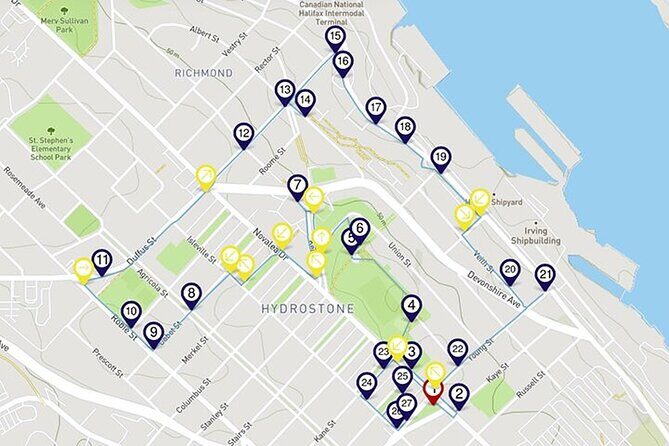
- Live GPS that nudges you forward: the map shows your position and where to go next, and the commentary triggers as you get close.
- A Jeff-led story starting at Hydrostone Park: you begin with the Hydrostone tragedy and recovery, not just a random history lecture.
- 27 short stops built for independence: each point is timed so you can keep moving without getting lost in long speeches.
- Trivia game at each stop (optional): tap your answer when the question pops up, if you want a little interaction.
- Free access tied to each stop: admission at stops is listed as free, which matters when you’re watching travel costs.
Entering the Halifax Explosion story at Hydrostone Park

Hydrostone Park is a smart place to begin because it sets the emotional tone early: this route isn’t built around big, dramatic viewpoints. It starts with a place connected to the aftermath, where people had to keep going even after the worst kind of catastrophe.
Your first stretch is about the Hydrostone area and the Memorial Bell Tower area, with the tour guiding you through the Hydrostone District and memorial points along the way. You’ll hear about survival stories that people still repeat for a reason, including the miracle of Ashpan Annie and the adventure of Billy Wells. The narration also connects the blast to what followed—especially the tsunami—so you understand that the damage wasn’t one single moment.
This is also where the tour’s design shows: it uses “small steps” to keep the story manageable. You’re not being asked to understand everything at once. You’re learning in pieces, at the exact places those pieces happened.
You can also read our reviews of more walking tours in Halifax



The audio-tour tech that keeps you from wandering off
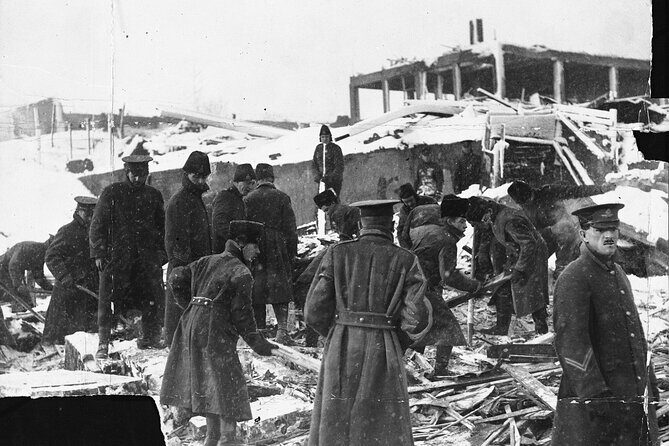
This isn’t a “download and hope” audio guide. You download the tour on Wi‑Fi before you leave, and then you use it during your walk with no data use required and no signal needed. That’s a big deal in Halifax because you don’t want your battery drain or service issues to bully your timeline.
Once you’re on the route, you get a live GPS map showing where you are and where to go next. As you approach each location, the tour guide commentary automatically plays, so you’re not constantly pressing buttons or guessing when the next section starts. Optional trivia pops up at stops after the commentary, and you can tap your guess right on your device.
Two practical notes you should know upfront. First, the audio is designed to come from your device speaker, since headphones are not included. Second, the tour is private: only your group participates, and the number of travelers you select is also the number of devices you can download the tour to.
Stop-by-stop: 27 moments across Richmond, Hydrostone, and the waterfront aftermath
Below is what the route takes you through, in the order you’ll encounter it.
Stop 1: Hydrostone Park
You’ll meet guide Jeff and begin at Hydrostone Park with the Memorial Bell Tower and nearby Hydrostone District memorials. Expect survival stories and cause-and-effect: the blast, Ashpan Annie’s miracle, Billy Wells, and the tsunami impacts.
Stop 2: St. Joseph’s Square
This short stop covers a memorial connected to the Catholic Parish of St Joseph’s. Even with just a few minutes here, it helps widen the lens beyond the most famous ship-and-explosion details.
Stop 3: Novalea Drive & Hennessey Place
You’ll learn how the park area began as military grounds and later transformed into a rebuilt neighborhood park with memorials. It’s a reminder that Halifax didn’t just repair buildings—it reshaped land use around the lives affected.
Stop 4: MC72+M7
This is where the ships and timeline come in: SS Mont Blanc, SS Imo, and the events leading up to the explosion. If you’re the kind of person who likes understanding the “how it started” part, this stop is one of the most important.
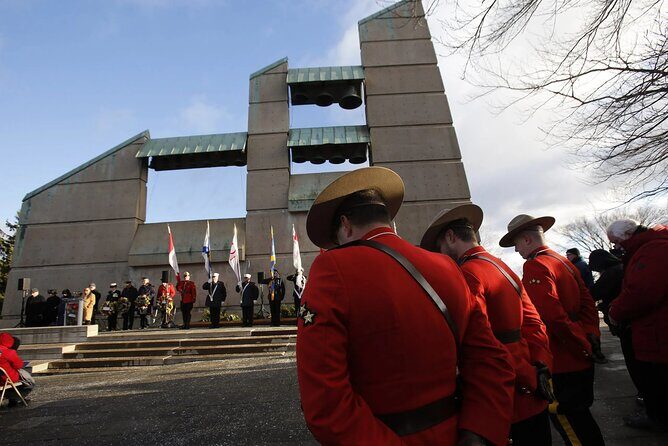
Stop 5: Halifax Explosion Memorial Bell Tower
You’ll return to the Memorial Bell Tower message, focusing on the monument to people from Halifax and Dartmouth who experienced firsthand the devastation. The goal here is to anchor the tragedy in named communities, not just headlines.
Stop 6: Fort Needham Memorial Park (Richmond Staircase)
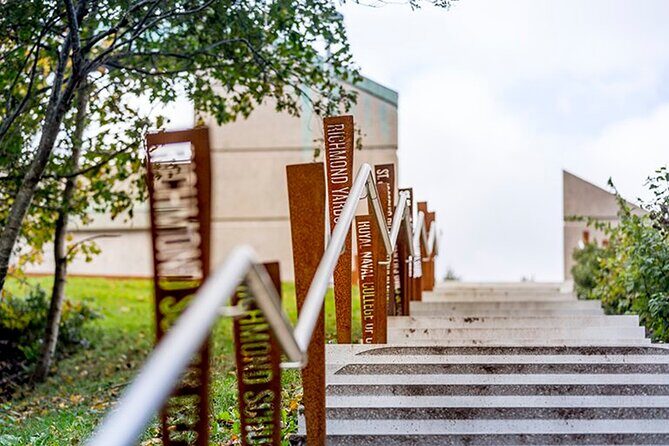
At the Richmond Staircase, you’ll hear about symbolism in the structure and railings, including names of businesses destroyed in the blast. This stop gives you a feeling for how a whole local economy could be wiped out in an instant.
Stop 7: Canada Family Court (Richmond School)
You’ll hear how this building was constructed immediately after the explosion and how the Roome School tragedy connects to it. It’s a hard topic, but the connection to a real building makes it easier to grasp.
Stop 8: M97V+Q8 (Secret of the Trees)
This stop shifts slightly from the explosion itself to the wood-lumber world tied to Halifax’s identity. You’ll hear about the Secret of the Trees and how it became infamous in lumber mills from Canada into the southern United States.
Stop 9: 3365 Robie St (Francis Mackey)
Here you’ll hear the story of Francis Mackey, the pilot onboard the Mont‑Blanc, and how the explosion profoundly changed his life. It’s one of the stops that turns “event history” into personal consequence.
Stop 10: Robie Street & Wells Street (Robie Street Water Reservoir)
This one is about practical survival: a reservoir built in 1913, its survival through the disaster, and its special designation. You get a reminder that firefighting and emergency response weren’t abstract—they depended on infrastructure.
Stop 11: M98R+44 (Patricia & her crew)
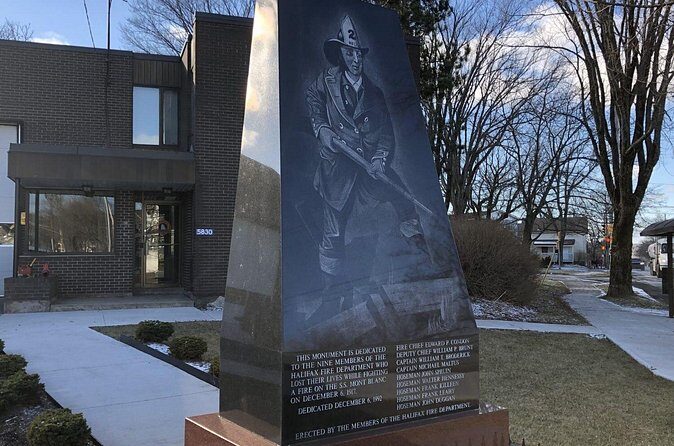
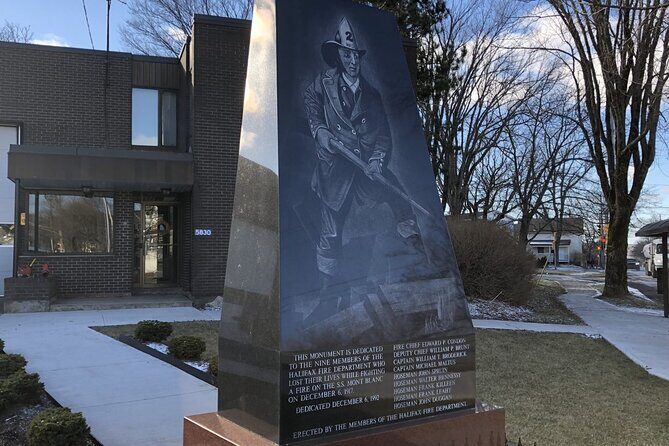
You’ll find a monument to firefighters who lost their lives, plus details about the “Patricia.” This stop gives the human cost of the rescue effort a clearer face.
Stop 12: M99W+82 (Fire & ice & black rain)
The narration turns toward conditions survivors faced—fire, ice-like impacts, and black rain. It’s the kind of description that can feel overwhelming, so pacing matters, and the tour’s short stop length helps you breathe between sections.
Stop 13: M99W+PH (Tsunami)
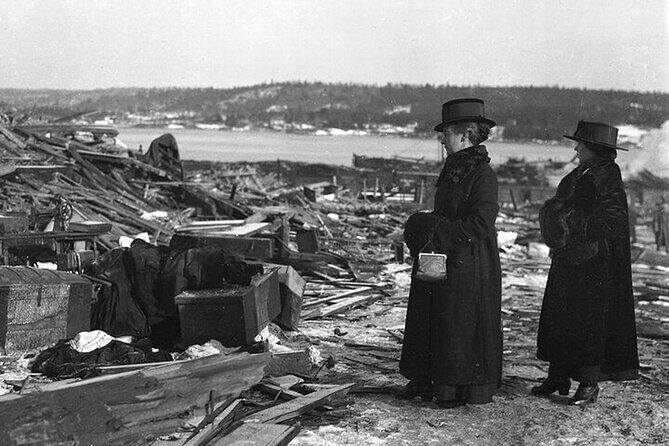
This stop describes how the tsunami swept up the hillside and how high it would have reached. It’s not just “a wave happened”—it’s positioned so you can picture the terrain and imagine the danger at your feet.
Stop 14: M99W+JR (House holes and the razing of Richmond)
You’ll see changes in the land around you and hear about ghostly markers of where people once lived and died. This is one of those stops where the walking path becomes a kind of memory map.
Stop 15: M9CX+66 (Vincent Coleman)
Here you’ll hear why Vincent Coleman is remembered as a hero who was credited with potentially saving hundreds of lives. Stops like this help you balance the story: tragedy plus courage.
Stop 16: Barrington Street & Duffus Street (Campbell Road as it was once known)
This stop gives you a “before” snapshot: Campbell Road as a wide dirt road lined with shops and houses. It helps you picture the neighborhood as a living place, not just an aftermath scene.
Stop 17: M99X+HQ (Ashpan Annie surprise)
You’ll get a good-news surprise tied to Ashpan Annie’s miraculous survival. It’s a gentle shift after heavier sections, and it keeps the tour from feeling purely grim.
Stop 18: Irving Shipbuilding Inc
You’ll hear about controversy around the structure and why it ended up being built there. This stop adds a layer about industry, choices, and how post-disaster decisions shaped what came next.
Stop 19: MC92+3J (Billy Wells)
You’ll get the amazing adventure of Billy Wells. For people who like narrative history—where characters matter—this stop tends to land well.
Stop 20: Veith House (Halifax Protestant Orphanage)
At Veith House, you’ll see a colorful memorial on a white picket fence painted by children from the Veith House. This is one of the most quietly moving stops because it ties the story to kids and their voices.
Stop 21: MC74+X2 (Royal Navy College)
You’ll hear about the Royal Navy College that stood across the road and how the efficiency of the co‑commander helped everyone survive. It’s a reminder that organization and timing can mean everything in emergencies.
Stop 22: MC72+7V (To the rescue)
This stop focuses on help Halifax received from around the world, plus a tradition that still continues today. It gives your walk a wider horizon beyond one neighborhood.
Stop 23: Novalea Drive & Kane Place (Hydrostone District planning)
You’ll learn about the town planner and the idea of English garden cities brought to Halifax. This is where rebuilding becomes urban design, not just construction.
Stop 24: M96X+WM (Hydrostone back lanes)
You’ll hear why “back-lane” business exists. This stop is practical in the way it explains how people lived and worked, and why the neighborhood layout makes sense.
Stop 25: Hennessey Place (Tudor Revival rowhouse cottages)
You’ll see the Tudor Revival design and hear about rowhouse cottages built for surviving families. It’s a visual way to grasp how recovery created new housing patterns.
Stop 26: MC62+M3 (Halifax Relief Commission Building)
Here you’ll learn about the committee formed to handle the emergency, and that the building is now designated a cultural historic site. This stop connects the story to systems—who organized relief and where that organization lived.
Stop 27: Hydrostone Market (final stop back at the start area)
You’ll end at Hydrostone Market. The tour frames this as a people-focused finale: not only monuments, but the people who lived through that day and raced to help. Your starting point is just across the road in the park, so the route stays tidy in your head.
How long it takes and how to pace yourself on this route
The tour runs about 1 hour 30 minutes to 2 hours 20 minutes. Even though each stop is designed for roughly five minutes, the real timing depends on how often you pause for reading, wind through streets, and how quickly your device triggers each auto-play segment.
A good approach is to treat the tour like a story you’re listening to, not a museum where you stand still. When the narration starts, take it in for that stop, then move on while your phone keeps its place. If you stop too long at one location, later stops can feel like they come too fast, especially since the subject matter is intense.
Also check the tour’s general opening hours: it’s available daily from early morning to late evening. That means you can choose a time that matches your comfort level with walking and weather.
Price and value: why $8.96 can still feel like a bargain

At $8.96 per person, this is priced for people who want depth without a big tour-ticket hit. The value comes from two things: the number of stops and how they’re structured.
You’re getting 27 short, location-based segments, many of which include key names and story threads—Jeff as the guide voice, plus figures like Ashpan Annie, Billy Wells, Francis Mackey, Vincent Coleman, and the firefighters tied to “Patricia.” You also get a live GPS experience and optional trivia, which helps the route feel guided even though it’s self-paced.
Finally, each stop lists admission as free, so you’re not stacking extra “entry fees” on top of the base price. That matters when your budget is tight and you still want a meaningful Halifax-focused experience.
A few more Halifax tours and experiences worth a look

What to watch for: audio from your speaker, plus weather reality
The biggest practical drawback is also the simplest: you provide the smartphone/tablet, and audio plays from your device speaker. In calm weather, that’s fine. In rain, wind, or noisy streets, it can be harder to catch details.
I’d plan for this. Bring a phone case if you can, keep your volume up enough to hear the narration, and don’t be afraid to pause the tour briefly if you need to get your footing in slick spots. Since the tour is yours to enjoy anytime, it’s smart to treat bad weather as a reason to change your time—not cancel your curiosity.
Another consideration is the tone. This is a disaster story with survival, death, and harsh conditions described in the narration. If you’re sensitive to heavy historical topics, pace yourself and take breaks rather than rushing through.
Who this Halifax Explosion audio walk is best for
This tour fits you best if you like a self-guided format but still want structure. You’ll enjoy it if you want to learn while walking, and you appreciate short stops that keep history grounded in place.
It also suits couples, solo travelers, and small groups who don’t want crowded pacing or tight schedules. Because it’s private, you won’t be boxed in by strangers changing your route rhythm.
On the other hand, it’s not the best match if you need a traditional live guide to answer questions on the spot, or if you hate listening to long narration from a phone speaker.
Should you book this Halifax Explosion Smartphone Audio Walking Tour?
Book it if you want a low-cost, well-structured way to understand the Halifax Explosion through the neighborhoods shaped by it. For the price, you get a ton of stop-by-stop storytelling, plus live GPS so you won’t feel lost in a residential area.
Skip it only if phone audio in the open air is a deal-breaker for you, or if you’re not comfortable walking at a moderate level for about 5 km. Otherwise, this is the kind of tour that makes you leave with names, places, and a clearer sense of how a community rebuilt itself after a day no one wanted to remember.
FAQ
How much does the Halifax Explosion Smartphone Audio Walking Tour cost?
The price is $8.96 per person.
How long is the tour?
It takes about 1 hour 30 minutes to 2 hours 20 minutes.
Is the tour guided, or is it self-paced audio?
It uses smartphone audio. Commentary automatically plays at each point of interest using your live GPS map.
Where does the tour start and end?
It starts at Hydrostone Park, 5547 Young St, Halifax, NS B3K 1Z7, Canada, and ends back at the meeting point.
Do I need mobile data during the walk?
No. You download on Wi‑Fi before you go, and no signal is required during the tour.
What do I need to bring?
You’ll need your own smartphone or tablet. Headphones are not included, and the audio is set to play from your device speaker.
What language is the tour available in?
The tour is offered in English.
Can I start or stop along the route later?
Yes. The tour can be started and stopped anywhere along the route.
Is it a private experience?
Yes. It’s private, and only your group will participate.
What if I need to cancel?
Cancellation is free up to 24 hours in advance for a full refund.
Does the tour work with a trivia game?
The trivia game is included and optional. You’ll tap your guess on your device when the question appears.