REVIEW · HALIFAX
Half-Day Historical Tour of Halifax
Book on Viator →Operated by Halifax Titanic Historical Tours · Bookable on Viator
Halifax history hits you from the harbor up. This small-group route shows you Pier 21 and the city’s biggest turning points, then swings over to Dartmouth and Fisherman’s Cove with a guide who keeps it moving. I especially like the way guide Paul mixes big-story facts with on-the-ground context, plus the tablet-style visuals that make the tough chapters easier to follow.
One possible consideration: the itinerary is timed, so if you’re on a tight cruise schedule, you may need to accept fewer stops or a brisk return walk.
Half-day and then-some can work really well here because you get broad coverage without feeling like you’re trapped on a bus all day.
Small group (max 10) plus pickup from downtown hotels or the port makes it feel smooth and personal, not like a stampede.
A drawback to plan for: you’re relying on fixed timing and transit, so bring a little flexibility if your departure window is narrow.
In This Review
- Key points before you go
- Why Halifax’s waterfront events shape the whole tour
- Price and Logistics: what $131.43 gets you (and what it doesn’t)
- The half-day flow: from Pier 21 to Dartmouth’s Fisherman’s Cove
- Pier 21 and early Canada stories at the harbor gateway
- Halifax Farmers Market: from 1750 livestock lots to 250+ vendors
- Art and immigration emotion: Armando Barbon’s family story
- Sir Samuel Cunard and the shipping engine of Halifax
- The boardwalk vibe and the geography advantage
- Georges Island: fortifications, tunnels, prisoners, and an early lighthouse
- Alexander Keith and the brewery that outlasted eras
- HMCS Sackville: WWII corvette and a living memorial
- Maritime Museum of the Atlantic: the smart add-on
- Maud Lewis: Nova Scotia folk art with a personal tone
- Historic Properties and Halifax’s preserved warehouse blocks
- Round Church and cathedrals: buildings that witnessed change
- Government House, Province House, and City Hall: how power formed here
- Downtown architecture attention: the stack-of-books style building
- The cemeteries that hold Titanic and Explosion memory
- Halifax Explosion Memorial Bell Tower and the rebuilding details
- Mont Blanc anchor and a small physical link to a huge event
- Seafood lunch option: Evan’s Seafood with views
- Dartmouth transition: Lake Banook and the ice hockey birthplace claim
- Fisherman’s Cove: the photo-friendly finish
- What the guide style adds (and why it’s repeatedly praised)
- The places you might want more time (so you can plan around them)
- Who this tour is for (and who should skip it)
- A quick practical note for cruise days
- Should you book this Halifax historical tour?
Key points before you go

- Max 10 people means you can actually hear your guide and ask questions.
- Paul’s multimedia (photos/videos in the van) helps connect landmarks to events.
- You’ll cover major WWII and maritime sites, plus Halifax Explosion memorials and cemeteries.
- The tour uses easy transfers from downtown hotels or Pier 22, minimizing your hassle.
- Short walks only at most stops, with a few longer-picture moments when it makes sense.
- You’re not stuck with just “downtown Halifax” since you also see Dartmouth and Fisherman’s Cove.
Why Halifax’s waterfront events shape the whole tour
If you want Halifax to make sense, start where the ships come in. This tour anchors you at the harbor and moves outward from there, so each new stop connects to the last one—immigration, naval power, disasters, rebuilding, and the everyday people who lived through it.
I like that it doesn’t try to be only “pretty landmarks.” You’ll stand near places tied to stories that changed how Halifax functioned and how people thought about survival and community—especially around the Halifax Explosion and the Titanic connection.
Another thing I like: the tour keeps a steady rhythm. You get a sequence of short, clear stops, then driving time for continuity. Even when topics are heavy, you won’t feel lost in a lecture-only format.
You can also read our reviews of more historical tours in Halifax



Price and Logistics: what $131.43 gets you (and what it doesn’t)

At $131.43 per person for an approx. 6-hour tour, the value here is less about a single ticket cost and more about the total package: guide time, transportation, and a route you likely won’t piece together yourself in a half day.
You’re paying for:
- A small-group guided route (max 10) across both Halifax and Dartmouth
- Round-trip transfers from any downtown hotel, or meeting at Pier 22 for cruise and self-drive
- On-board comfort: air-conditioned van, bottled water, and WiFi
What you should budget separately:
- Lunch is not included (though you can stop for seafood if you want)
- Gratuity is not included
- Some attractions have admissions and won’t be covered the same way at every stop (for example, Citadel admission is not included)
For first-timers, the math often works: the guided plan saves time and gets you to multiple “worth it” sites without needing to drive between them.
The half-day flow: from Pier 21 to Dartmouth’s Fisherman’s Cove
This isn’t a slow “wandering” day. It’s structured like a story, with stops that build on each other. Here’s how the tour feels as it moves along.
Pier 21 and early Canada stories at the harbor gateway
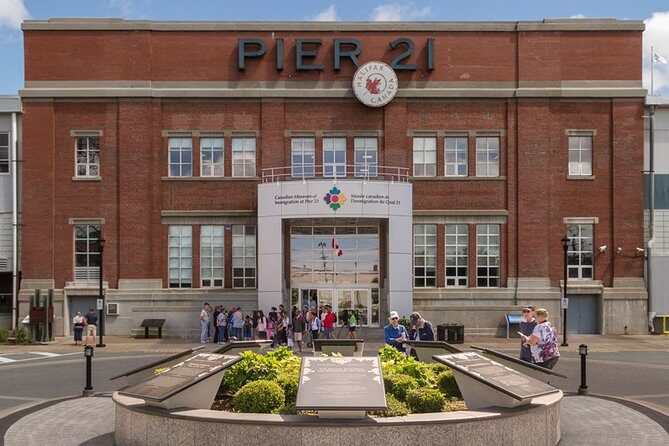
The day opens at Pier 21, described as the Gateway to Canada. That matters because it frames Halifax as a doorway—not just a place to look at from the sidewalk.
From there, you start learning how the port’s role shaped the city’s identity and connections far beyond Nova Scotia.
Halifax Farmers Market: from 1750 livestock lots to 250+ vendors
Next up is the Halifax Farmers Market story. It began by Royal Proclamation in June 1750, a year after Halifax’s founding, and the original site was designated for what was described as a livestock and produce market. Over time, it’s moved locations, including a modern move to the Halifax Seaport area in 2010.
The key takeaway for you: this isn’t just about food. You’re seeing how the city’s public spaces evolved from early colonial commerce into an ongoing community institution.
A few more Halifax tours and experiences worth a look



Art and immigration emotion: Armando Barbon’s family story
A stop on a sculpture that tells a migration story stands out for its human scale. Armando Barbon emigrated from Italy in 1951. The artwork references the pain of separation, and the family’s eventual arrival—something you’d never guess by walking past it casually.
If you like Halifax history that includes the emotional side (not only dates and battles), this moment lands.
Sir Samuel Cunard and the shipping engine of Halifax
You’ll hear about Sir Samuel Cunard, Halifax-born founder of the Cunard Line. The point isn’t just who he was—it’s why shipping mattered so much to Halifax’s economy, influence, and global connections.
The boardwalk vibe and the geography advantage
Halifax’s shape is part of the story. The tour calls out a long downtown boardwalk and highlights the harbor’s massive scale. It’s one of those “stand here and you’ll understand why people fought over this place” moments—without needing a military textbook.
Georges Island: fortifications, tunnels, prisoners, and an early lighthouse
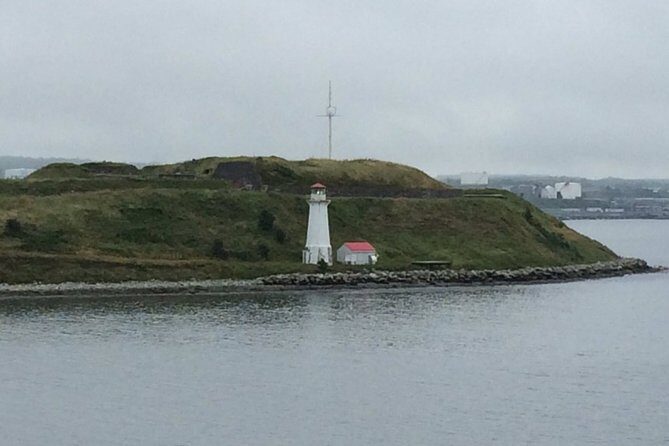
Georges Island is one of the tour’s big historical swings. You’ll learn how British military forces used its strategic location, and how it became central to seaward defenses for a British naval station in the 18th and 19th centuries.
You also get the layered use of the island over time:
- Fort Charlotte and powerful seaward-facing batteries
- Underground tunnel complex
- An early automated lighthouse
- Use as a prison during the Acadian deportation period (1755 to 1763)
This is also where local folklore enters the picture, tied to the island’s tunnels and mysterious passages. Even if you don’t love ghost stories, the history behind them is fascinating.
Alexander Keith and the brewery that outlasted eras
Next, the tour shifts gears to Alexander Keith and his Nova Scotia Brewery. It’s framed as nearly 200 years old, still operating today, and connected to local culture and Keith’s heritage.
For you, it’s a palate cleanser after the heavy memorial content—plus it shows that “history” isn’t only tragedy and war.
HMCS Sackville: WWII corvette and a living memorial
You’ll also hear about HMCS Sackville, Canada’s naval memorial and the only one of its Allied corvettes from World War II that remains. It’s a National Historic Site, which helps you understand why this stop carries weight even if you’re not a “naval person.”
Maritime Museum of the Atlantic: the smart add-on
The tour strongly recommends visiting the Maritime Museum of the Atlantic either before or after. The museum’s emphasis on convoys, sailing days, the age of steam, and major events like the Titanic and Halifax Explosion is exactly the kind of context that makes the outdoor stops hit harder.
If your schedule allows, you’ll get the most payoff by doing this museum on the same trip window.
Maud Lewis: Nova Scotia folk art with a personal tone
You’ll hear about Maud Lewis, a famous Nova Scotia folk artist. On a day full of large historic forces, this stop adds something human and creative.
Historic Properties and Halifax’s preserved warehouse blocks
Historic Properties is highlighted as Canada’s first restoration project of its kind, featuring three city blocks of some of the oldest surviving waterfront warehouses and Victorian-Italianate facades from the late 1700s and early 1800s.
This is a strong photo stop for you if you like architecture that still looks old enough to carry stories.
Round Church and cathedrals: buildings that witnessed change
You’ll cover multiple religious and civic landmarks, including:
- The Round Church (Saint George’s), a cylindrical wooden church built in 1800 in Palladian style
- The oldest Anglican cathedral building outside England, with notable references like the Ghost Window and wood embedded from the 1917 Halifax Explosion
- Saint Mary’s Cathedral Basilica with Gothic Revival architecture
- Additional downtown church and cathedral stops tied to Halifax’s changing communities
These places help you understand Halifax as a city of different faiths and changing populations—often shaped by the same events that impacted shipping and disasters.
Government House, Province House, and City Hall: how power formed here
The tour also points out the city’s governance landmarks:
- Province House, Canada’s oldest legislative building and home to the first elected House of Assembly
- Government House, the oldest official residence in Canada and home to the Lieutenant Governor of Nova Scotia
- Halifax City Hall, built 1887 to 1890 and designated a National Historic Site
If you want Halifax history that explains “who made decisions” and not just “what happened,” these stops help.
Downtown architecture attention: the stack-of-books style building
There’s also a stop where the architecture is described as resembling a stack of books and has been featured by CNN. The point for you isn’t internet fame—it’s the reminder that Halifax keeps evolving visually, not only historically.
The cemeteries that hold Titanic and Explosion memory
After the downtown core, you move into places where the city’s losses are recorded in stone.
You’ll see multiple cemeteries and memorials, including:
- Camp Hill Cemetery (notable interments include Viola Desmond, Alexander Keith, Joseph Howe, and Titanic survivor Hilda Mary Slayter)
- Mount Olivet Cemetery, described as the Forgotten Titanic Cemetery, with markers for Roman Catholic Titanic victims and stories tied to Margaret Rice and “Ashpan Annie”
- Fairview Lawn Cemetery, where Titanic victims and Halifax Explosion victims are interred
- Our Lady of Sorrows Chapel at Holy Cross Cemetery, built in one day (with French stained-glass windows referenced as dating to the 16th and 17th centuries)
This section is where the guide’s handling matters. The tour’s overall tone (as reflected in the guide’s approach) keeps it respectful, not sensational. If you want disaster history without a showy vibe, you’ll appreciate that.
Halifax Explosion Memorial Bell Tower and the rebuilding details
One of the emotional centers of the tour is the Halifax Explosion Memorial Bell Tower on Fort Needham. You’ll hear the scale of impact—deaths, injuries, and homelessness—plus how survivors rebuilt Halifax and Dartmouth.
You’ll also learn about reconstruction choices, including the use of hydrostone for non-combustible rebuilding blocks, and you’ll hear about a cannon thrown nearly three miles to Albro Lake in Dartmouth and later recovered.
This is where “history” becomes engineering and policy: what people did next, how they reduced future fire risk, and how the city stayed standing.
Mont Blanc anchor and a small physical link to a huge event
A short stop includes the Mont Blanc anchor site: an anchor shaft weighing about 1140 lbs that flew 2.3 miles after the 1917 explosion. This is the kind of detail that sticks because it’s tangible.
Seafood lunch option: Evan’s Seafood with views
There’s an optional lunch stop at Evan’s Seafood with fresh Nova Scotia seafood and an amazing view of Halifax. Food orders are phoned ahead to speed things up, which helps keep the day on track.
If you’re not hungry, you can still enjoy the view, but you’ll likely want to eat something after this amount of walking around history.
Dartmouth transition: Lake Banook and the ice hockey birthplace claim
Once you shift into Dartmouth, the tour introduces Lake Banook and its clubs. You’ll also hear the claim that it’s the birthplace of ice hockey—one of those Halifax-area stories that gives the day a “you didn’t expect this” moment.
Fisherman’s Cove: the photo-friendly finish
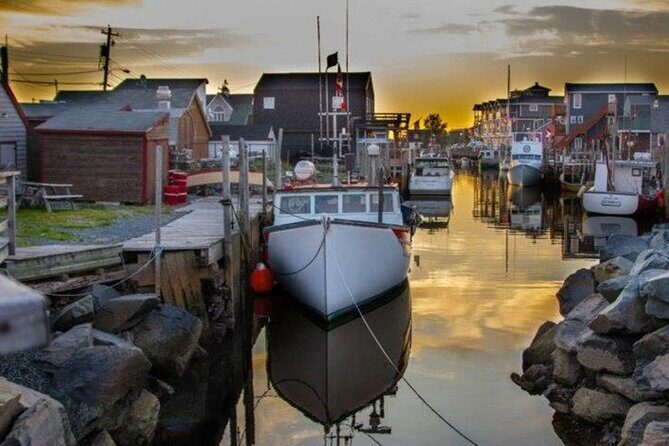
You’ll end with Fisherman’s Cove, a restored, colorful fishing village that’s about 200 years old. Expect lots of photo moments, and a gentle closer to the day after the intensity of memorial stops.
What the guide style adds (and why it’s repeatedly praised)

A lot of tours show you places. This one tries to explain why those places matter, and the guide style drives that.
From the way Paul runs it, these are the standout strengths:
- Strong organization and timing so you don’t feel like you’re guessing what’s next
- Tablet-style visuals that support the stories, not distract from them
- A tone that treats Titanic and the Halifax Explosion with the seriousness they deserve
- Extra attention to side details people often miss, including photo angles and less-obvious locations
If you care about context—how Halifax got shaped—this is the kind of guide-led format that delivers.
The places you might want more time (so you can plan around them)

Because this is a half-day, it has to skim the surface on some things that could take hours. If you’re the type who wants to linger in museums or spend long periods outside, keep your expectations realistic.
A good example: the Maritime Museum of the Atlantic is recommended separately because it can’t be fully covered during a timed route. The same idea applies to any site where you’d want to read every plaque slowly.
That said, the tour includes enough viewpoints and short walks that you still feel you’ve “done” Halifax and Dartmouth—just not at the slow pace of independent exploring.
Who this tour is for (and who should skip it)
You’ll likely love it if:
- You’re short on time in Halifax but want major landmarks and big event context
- You care about maritime stories, including Titanic and the Halifax Explosion
- You prefer a small-group experience with a guide who can answer questions
- You want easy pickup and transportation so you don’t have to coordinate multiple rides yourself
You might want to choose something else if:
- You want a museum-heavy day with long indoor time
- You’re allergic to schedules and want zero time pressure
- You’re only interested in one narrow topic and don’t care about cemeteries, governance buildings, and broader maritime context
A quick practical note for cruise days
If you’re sailing with a strict tender or departure time, plan this like a “return-on-time” mission. Build in buffer and double-check where you’ll be dropped so you can manage any walk-back if needed. The tour aims to keep commitments, but your ship schedule is the real boss.
Should you book this Halifax historical tour?

If you want a half-day that actually teaches you Halifax—not just a highlight photo reel—this is a strong choice. The small group size, Paul’s structured storytelling with visual support, and the mix of harbor sites, Dartmouth stops, and memorial-focused moments make it a high-value way to understand the city fast.
Book it if you want the big stories with real locations behind them. Skip it if your ideal day is slow museum browsing or no schedule at all.