REVIEW · KINGSTON
Orignal Haunted Walk of Kingston 75-Minute Ghost Tour
Book on Viator →Operated by Haunted Walk of Kingston · Bookable on Viator
Kingston feels creepier after the sun drops. This 75-minute ghost walk mixes local storytelling with major landmarks, so you get a spooky side of downtown without it turning into a long slog. You’ll also have multiple evening start times to fit your schedule.
What I love most is the stop-and-story format and the way it threads through Kingston’s best-known buildings. You’re not just wandering; you’re learning why places like Kingston City Hall, the Public Market, and St. George’s Cathedral matter. Another big plus: it’s a small group (up to 16), which makes it easier to hear clearly and ask questions.
One thing to plan for: it runs at night and is weather dependent, so cold or poor conditions can make the walk less fun. Also, like any live show, the energy can vary a bit by guide, even if the event is consistently well run.
In This Review
- Key highlights to know before you go
- Kingston After Dark: How the City Changes in 75 Minutes
- Price and What $25.45 Buys You in Value
- Meeting at 200 Ontario Street and Getting Oriented Fast
- Stop 1: Kingston City Hall, Capital-Era Architecture, and Big-Deal Drama
- Stop 2: The Oldest Market in Ontario Gets a Spooky Twist
- Stop 3: Hochelaga Inn (1879) and a Haunted Hotel Favorite
- Stop 4: Chalmers Free Presbyterian Church → Chalmers United Church
- Stop 5: St. George’s Cathedral and the Fire-Then-Rebuild Story
- How the Walk Really Feels: Pace, Dark Streets, and Weather
- Guides, Acting Style, and Why Names Matter
- Who This Tour Is Best For
- The Quick Read: Should You Book Haunted Walk of Kingston?
Key highlights to know before you go
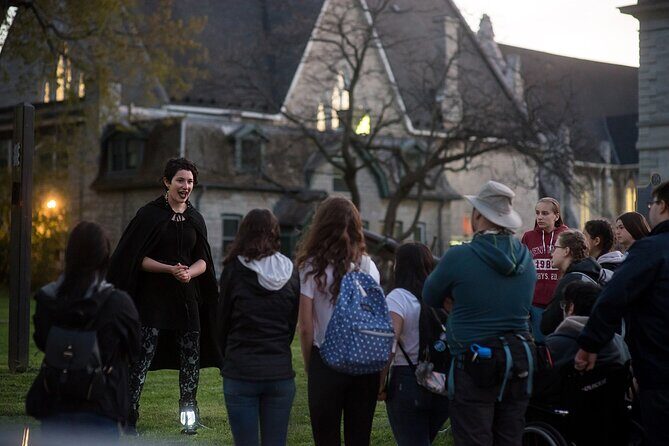
- Small group size (max 16) keeps the pace friendly and questions welcome
- Historic stops range from capital-era architecture to haunted church legends
- Evening scheduling with multiple start times helps you match your day
- Low-lit streets mean a flashlight can make a difference
- Professional guides/storytellers drive the whole experience
Kingston After Dark: How the City Changes in 75 Minutes
A ghost walk works best when it does two jobs at once: it guides you through real places, and it gives those places a second meaning. This one does both. You start with waterfront views near the tour office, then shift into downtown streets where the light gets lower and the stories get sharper.
The other smart thing is how tightly the route stays within about 1 hour 15 minutes. That matters if you’re traveling with kids, if you’re on a couples-friendly schedule, or if you simply don’t want to lose an entire evening to walking. The tour is built around occasional stops where the guide tells the story, then you move on. That rhythm keeps it from dragging.
And Kingston itself helps. Even without the ghosts, the downtown has that compact, walkable feel. With the tour running at night, you notice details you’d normally skip in daylight: street corners, building facades, and the way landmarks sit in the urban layout.
You can also read our reviews of more walking tours in Kingston
Price and What $25.45 Buys You in Value
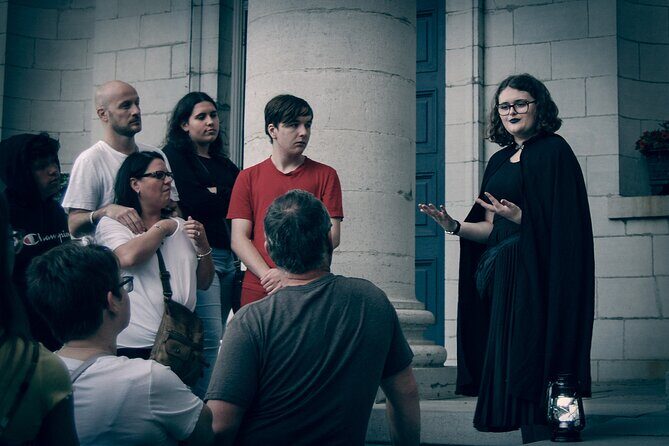
At $25.45 per person, this ghost walk lands in the practical “worth it if you like stories” zone. You’re paying for a professional guide/storyteller, a small-group walking route, and timed storytelling stops at several notable buildings.
The value isn’t just the spooky theme. It’s the combination of:
- Guided interpretation of landmarks that actually have documented dates and roles in Kingston’s growth
- A format that’s short enough to pair with dinner or other evening plans
- A cap of 16 travelers, which tends to make the experience feel more personal than big group tours
If you’re the type who enjoys local legends but also likes the factual anchors (who built it, when it changed, what happened after fires and renovations), you’ll likely find the price easy to justify. If you’re hoping for long theatrical effects every step, you might want to note that the core is storytelling tied to real locations, not a full staged production.
Meeting at 200 Ontario Street and Getting Oriented Fast
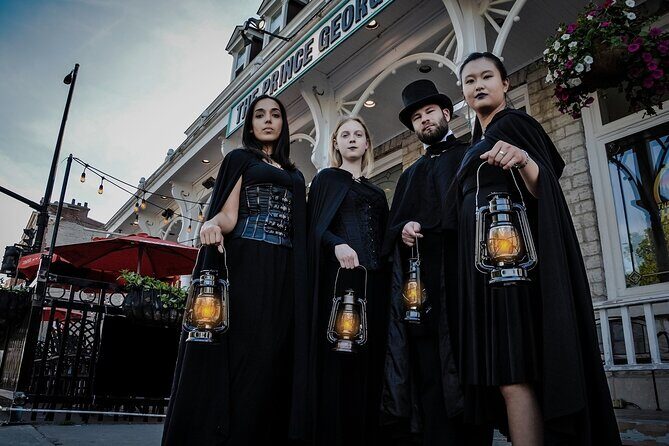
Your tour begins at 200 Ontario St, Kingston, ON K7L 2Y9, right by the Kingston Waterfront views from the ticket office area. That’s a solid start because you get an immediate sense of place. Even before the first major stop, you’re orienting yourself to where Kingston sits and how downtown connects to the water.
The process is also travel-friendly: you’ll have a mobile ticket, so you aren’t hunting for printouts. The tour is in English, and it’s near public transportation, which helps if you’re stacking it with other plans.
Practical tip: dress for night walking. The route includes low-lit streets, and that’s not a minor detail. One of the clearest pieces of advice you’ll hear is that a flashlight can help you see where you’re stepping, especially if you’re not used to dark city sidewalks.
Stop 1: Kingston City Hall, Capital-Era Architecture, and Big-Deal Drama
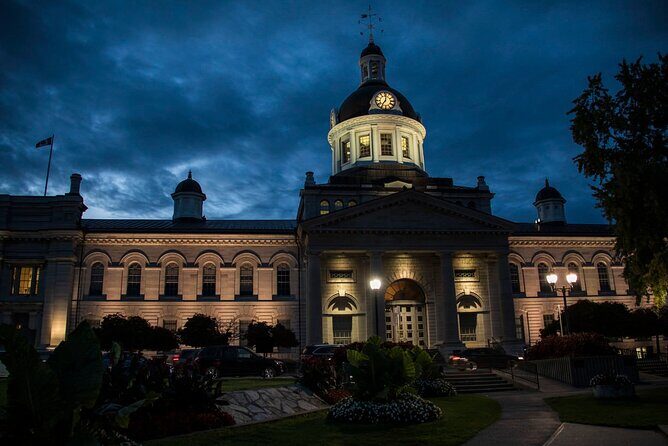
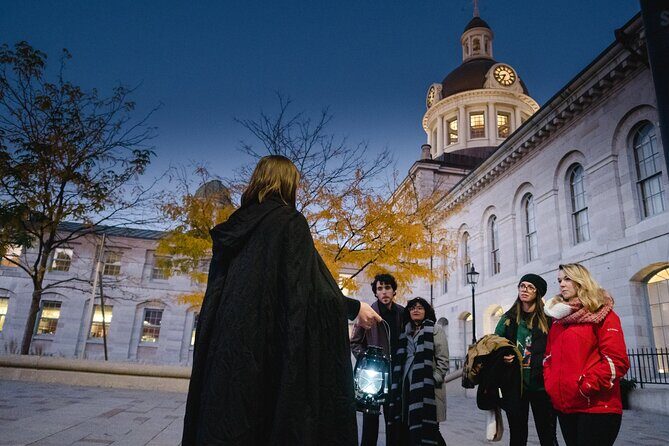
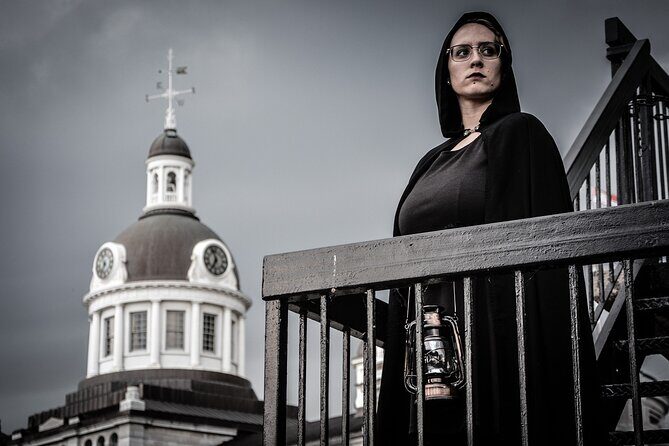
One of the first stops is Kingston City Hall, completed in 1844. The story here is the scale and design that reflect Kingston’s status as the capital of the Province of Canada at the time.
You’ll also hear how the project came together: the architect selected in 1841 was George Browne, and City Hall was later designated a National Historic Site of Canada in 1961. That blend of documented civic importance plus a guided ghost narrative is a big part of why this tour works. The building isn’t just a backdrop—it’s a reason the stories have weight.
What to watch for: since you’re learning at night, the guide may point out visual cues on the facade or describe historical context you’d otherwise miss. This is where small-group size matters. You can usually hear the explanation without straining, and you can ask for clarification right there.
Stop 2: The Oldest Market in Ontario Gets a Spooky Twist
Next comes the Kingston Public Market, described as the oldest market in Ontario, serving the community since 1801. Markets are perfect ghost-walk territory because they’re human places: commerce, gossip, routine, and the constant motion of everyday life. Then the guide layers in the eerie angle.
If you like stories tied to real social spaces, this stop is a treat. You’re not just hearing about a single haunted room—you’re hearing about a location that has been part of community life for a long time.
One consideration: markets and downtown streets can feel busy or change lighting quickly. At night, that can make it harder to follow hand gestures or details on buildings. If you’re sensitive to darkness, your flashlight (and warm layers) help you stay comfortable and present.


Stop 3: Hochelaga Inn (1879) and a Haunted Hotel Favorite
The tour then shifts to Hochelaga Inn, built in 1879 for John McIntyre, a prominent Kingston lawyer and mayor. The operator frames it as their favorite haunted hotel in the city, and the point isn’t only the scary label—it’s the way the story connects the building to Kingston’s power structure and social life.
Hotels tend to spawn legends because they see everyone: travelers, locals, business meetings, arguments, and quiet moments. The guide turns that general idea into a Kingston-specific narrative tied to the people and era connected to the building.
If you enjoy the moment when a ghost story explains why something in a building would matter to real people, this stop is likely to stick with you.
Stop 4: Chalmers Free Presbyterian Church → Chalmers United Church
After Hochelaga, you’ll hear about a building with a timeline baked into its identity. It was constructed in 1890 as The Chalmers Free Presbyterian Church. Later, it was renamed Chalmers United Church in 1925 when the United Church of Canada came into being.
The guide connects that transformation to a ghost story associated with the building. That’s one of the clever parts of the whole walk: you get a sense of how communities evolve, and then you get the supernatural angle that people attach to places that have seen change.
Why this matters for you: if you’re traveling and want more than generic scare tactics, storylines that include dates and community shifts make the supernatural feel more grounded. It’s less random spooky and more like local mythology with an address.
Stop 5: St. George’s Cathedral and the Fire-Then-Rebuild Story
The final set piece is the cathedral area, tied to the first organized Anglican parish in Ontario. The congregation dates to 1783, and the story traces to 1825 when St. George’s replaced a smaller structure built in 1792.
You’ll hear architectural specifics that make the legends feel anchored:
- The core of the existing church was built of stone to the design of Kingston architect Thomas Rogers in 1825.
- The church was substantially enlarged in the 1840s, with a nave bay, a large clock tower, and an entrance portico with a pediment supported by four columns.
- It was completely gutted by fire in 1899, then quickly rebuilt under Joseph Power & Son.
- In 1975, the City of Kingston designated the church under the Ontario Heritage Act.
- In 1981, the Ontario Heritage Trust secured a heritage easement.
Even if you’re not the kind of person who goes looking for haunted tours, this stop tends to win people over because it’s both dramatic and factual. The fire-and-rebuild piece alone is the kind of real-life turning point that naturally fuels stories people keep telling.
What to keep in mind: by the time you reach this stop, you may be a bit cold (especially if you booked an evening in fall or winter). Warm layers and a scarf help you focus on the guide instead of your circulation.
How the Walk Really Feels: Pace, Dark Streets, and Weather
This tour is a nighttime stroll. That sounds obvious, but the details matter. The route includes low-lit streets, and one review specifically suggests bringing a flashlight. I’d treat that advice seriously. A small flashlight can help you navigate uneven sidewalks and keep the experience from turning into, I hope I don’t trip.
The tour also requires good weather. If poor weather cancels it, you’ll be offered a different date or a full refund. That’s a fair trade for a walking format, but it does mean your plan might shift at the last minute if you’re traveling in a season with unpredictable nights.
Also, the group size stays modest with a maximum of 16 travelers. That’s important because it affects the flow. In big ghost tours, you hear half the story. Here, the small size tends to make the guide’s voice and pacing easier to follow.
Guides, Acting Style, and Why Names Matter
A ghost walk lives or dies on delivery. You can see that in the range of guide styles described in the experience data. Some guides are praised for being very clear, very animated, and willing to answer questions in a steady way. Others are praised for dramatic reenactments and a more theatrical approach, including moments like capes and lantern-style staging.
Guides mentioned include Rebecca, Marie, Tamara, Mya, Allison, Arianne, Amy, Chips, Tyra, Alison, and India. That’s a lot of names, which suggests a consistent roster and also that delivery can vary from guide to guide.
So here’s the practical takeaway: if you want a high-energy storyteller, pick a time slot where you expect the group to be in a good mood. And if you prefer a calmer pace, show up with the mindset that the goal is guided storytelling, not jump-scare horror.
Who This Tour Is Best For
This is a solid choice for a range of travelers because the format is short and the focus is both spooky and historical.
You’ll likely enjoy it if:
- You like local legends tied to real buildings
- You want an evening activity that doesn’t run hours
- You enjoy asking questions, since the small group helps discussions stay manageable
- You’re okay with walking at night and dressing for cooler temperatures
It’s also a nice date option. Couples tend to like the balance of mood and information. Families can work too, as long as kids are comfortable with a nighttime walk and the occasional chill-down-your-back feeling.
One helpful note for many travelers: leashed pets are warmly welcomed, so if your travel style includes bringing your dog, this can fit better than many other evening tours.
The Quick Read: Should You Book Haunted Walk of Kingston?
Book it if you want an evening that mixes Kingston landmarks with a storyteller’s pace—and you’re happy to walk through downtown after dark for about 75 minutes. The price is reasonable for a guided small-group route, and the stop list is strong: City Hall, the Public Market, Hochelaga Inn, Chalmers, and the cathedral area all bring specific, date-based details that make the stories feel anchored.
Skip it only if you know you dislike night walking in cooler weather or you’re looking for a heavy-effects performance rather than history-and-legend storytelling. Also, because guide energy can vary, plan to go in with an open mind about the storytelling style.
If that sounds like you, I’d put this at the top of your Kingston evening options.