REVIEW · NIAGARA FALLS AND AROUND
Niagara Peninsula: a Smartphone Audio Driving Tour
Book on Viator →Operated by Tripvia Tours · Bookable on Viator
Niagara, explained as you drive. This smartphone audio driving tour strings together major Niagara highlights and lesser-known stops with stop-by-stop narration you control. I especially like the offline audio setup (once downloaded, it uses no data) and the sheer variety of themes—gardens, canal engineering, and War of 1812 history in the same loop.
One heads-up: you’ll need to spend a few minutes on your phone before you start rolling, including downloading content with mobile or Wi‑Fi. Also, don’t rely on turn-by-turn from Apple or Google Maps; the audio includes what you need when you’re along the route.
In This Review
- Key Points Before You Hit the Road
- Niagara Peninsula Audio Tour: the smartest way to see more with less stress
- Price and timing: $8.95 for up to 15 people is the real bargain
- Setup and logistics: one download, then no signal needed
- How to avoid the most common frustration
- Start here at 5900 Niagara River Pkwy, then drive your own pace
- Floral Clock to Niagara Gorge: the Niagara power story, told stop by stop
- Botanical Conservatory and 99 acres of gardens: where the tour slows down
- Walker family farm shop: pies and practical souvenirs
- War of 1812 story stops: forts, Redan Gun, and the tiny church tale
- Niagara-on-the-Lake and Upper Canada: pretty town vibes with historical weight
- Free city zoo and Port Weller: family-friendly stops with real purpose
- Canal engineering that you can actually understand: ships, Bridge 21, and Lock 8
- Port Promenade: watch the giant ships waiting their turn
- Lock 8: not a lift lock
- From Fruit to Nuts, Benchlands markets, and local-road surprises
- Underground Railroad and early pioneers: Saylem Chapel and David Morgan
- What makes this section valuable
- Fort Erie and Navy Island: battlefield sites along the Niagara River
- Wetlands, birds, and the Quarry Road nature stop
- A memorial pause
- International Railway Bridge and the grand finale at Niagara Falls
- Who this tour is for (and who should skip it)
- Should you book Niagara Peninsula: a Smartphone Audio Driving Tour?
- FAQ
- How much does the Niagara Peninsula smartphone audio driving tour cost?
- How long does the tour take?
- Do I need internet or mobile data during the tour?
- What language is the tour audio in?
- What device do I need to use the tour?
- Do I need to use public transportation?
- Where does the tour start and end?
- Is there a time limit or can I go at my own pace?
Key Points Before You Hit the Road

- Offline after download: you need a solid connection to start, then the tour runs without signal and uses no data.
- Great value for groups: $8.95 per group (up to 15 people) for a 3 to 4 hour self-drive.
- A theme-rich route: florals, waterfalls, the Niagara Gorge, conservation areas, canals, and forts—done in one driving loop.
- One booking per vehicle: you only need a single reservation for each car.
- Private by default: only your group participates, so it’s not a crowded bus experience.
- Real-world pacing: no time constraints, so you can linger where you care and skip what you don’t.
Niagara Peninsula Audio Tour: the smartest way to see more with less stress
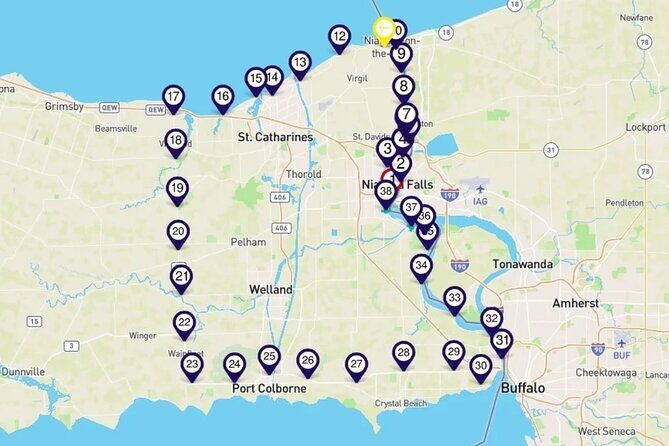
If you like Niagara Falls but hate the stampede feeling, this style of tour can fit your trip better than a bus schedule. Instead of rushing, you can treat this like an audio-guided road trip: you drive your own car, stop when it makes sense, and let the narration do the explaining.
I love how the route mixes big-name stops with surprises that feel like local knowledge. You’ll get the story behind the Niagara Gorge and the whirlpool, then switch gears to botanical gardens, farm goods, canal history, Underground Railroad clues, and battlefield sites along the river.
A few more Niagara Falls and Around tours and experiences worth a look


Price and timing: $8.95 for up to 15 people is the real bargain

At $8.95 per group (up to 15 people), the price is unusually friendly for Niagara. The value isn’t just the cost—it’s that one booking covers your whole car, and the experience is designed to last about 3 to 4 hours on average while still letting you go longer.
Because this is booked ahead (on average, about 22 days), it’s a good idea to reserve early if you’re traveling during peak season. The nice part is that you’re not locked into a tight live-tour window; you choose flexible dates tied to the tour availability.
Setup and logistics: one download, then no signal needed

This is a smartphone tour, and that matters. You’ll need your own smartphone or tablet and headphones or speaker audio you’re comfortable with. The good news is that you only need a good mobile or Wi‑Fi connection for the initial download.
After that, you can keep driving with no signal and no data used during the tour. That can save you from roaming charges and reduces anxiety when cell coverage gets spotty near parks and river corridors.
How to avoid the most common frustration
You might run into the “why won’t this start” problem on day one if your phone isn’t ready at the start. Set aside a short buffer at your starting point to download everything first. And when it comes to directions, let the audio guide you—turn-by-turn from separate apps isn’t required since the narration includes what you need.
Start here at 5900 Niagara River Pkwy, then drive your own pace

The tour starts and ends at 5900 Niagara River Pkwy, Niagara Falls, ON L2E 7M7. That makes planning simpler because you’re not hunting for a random downtown pickup and you can park like a normal road trip.
Opening hours run from 5:00 AM to 10:00 PM daily. In practice, you’ll want daylight for getting out and walking, especially around gardens, canal viewpoints, and history sites where the narration points you to what to look for.
The tour is private for your group, and it’s only one booking needed per vehicle. So if you’re traveling as a small crew—friends, family, or a multi-generation group—it’s a smooth setup.




Floral Clock to Niagara Gorge: the Niagara power story, told stop by stop
You’ll begin your “Niagara explained” phase with a landmark that’s easy to miss if you’re only focused on the falls. The Floral Clock (created in 1950) is one of the largest floral clocks in the world, and the design changes each year. It’s a fun opener because it instantly tells you this peninsula trip isn’t only about water—it’s also about design, seasons, and public art.
Next comes the Niagara Gorge, once a mecca for thrill seekers. The narration frames it in terms of why people came running—so you’ll understand the geography before you even reach viewpoints.
Then you hear about the whirlpool created by high-velocity water flowing downstream. Even if you’ve seen Niagara before, this section helps you connect what you’re seeing to the mechanics behind it. That’s the kind of explanation that makes a road trip feel like more than just photos.
What to consider: these “get your bearings” stops are best when you’re willing to pause briefly. If you’re the kind of traveler who never wants to step out of the car, you’ll miss part of the point.
Botanical Conservatory and 99 acres of gardens: where the tour slows down

After the gorge and river energy, the route shifts into slow-walk territory. The glass dome conservatory covers 11,000 square feet with lush jungle conditions, meandering pathways, and cooling waterfalls. It’s the kind of stop where the audio makes sense because you’re learning while you wander indoors.
You’ll also hit a 99 acres garden area with flowers, trees, and aromatic herbs, plus paths and benches. That “benches included” detail matters for comfort. Niagara can be a lot of walking plus wind and sun; having seating spots makes it easier to enjoy the narration instead of constantly checking your watch.
Walker family farm shop: pies and practical souvenirs
One of the more charming stops is the farm shop opened by the Walker family in the 1930s. You can look at fresh fruit, jams, pies, butter tarts, or boxed lunches, and the shop sources items from the family’s own farm.
Even if you don’t buy anything, this is a great place to reset. You’re surrounded by local-food logic instead of tourist trinkets, and you can grab something for later in the drive.
Drawback to plan for: if you’re visiting in a season when certain places are closed or inaccessible, you may need to adjust your stopping strategy. The tour notes that recommended attractions can be closed beyond the provider’s control.
War of 1812 story stops: forts, Redan Gun, and the tiny church tale

Niagara Peninsula is loaded with 19th-century conflict, and this tour makes sure you actually understand the setting—not just the locations. You’ll learn how British Regulars, Canadians, and First Nations allies fought off an American invasion in the War of 1812.
Then comes the Redan Gun—and you’ll get the meaning behind the term. This kind of explanation is valuable because it turns a weird name into something concrete you can picture when you stand near it.
You’ll also hear about an impressive Georgian manor that was once Niagara’s finest residence. It’s a straight-up change of pace from battle history—more about the people who lived in power during a turning point era.
And yes, you’ll get the story behind the claim that the area has the smallest church in the world, with four pews, a tiny apse, and two Bibles. Whether you treat the claim as literal or legend, it’s still a memorable, easy-to-grasp piece of local culture.
Niagara-on-the-Lake and Upper Canada: pretty town vibes with historical weight

If you’re heading toward Niagara-on-the-Lake in your planning, this tour basically gives you a reason beyond scenic streets. You’ll hear that Niagara-on-the-Lake was once the capital of Upper Canada, and you’ll also get the local take that it may be the prettiest town in Ontario.
If history is your thing, that capital detail gives you a frame for the buildings and streets you see. If history isn’t your thing, this segment still works because you’re pairing facts with a town that’s easy to like.
The audio rhythm here helps too: it’s not nonstop. You can walk a bit, pause, and then let the next story land when you’re ready.
Free city zoo and Port Weller: family-friendly stops with real purpose
This tour includes a free zoo on city land (owned and operated by the City of Saint Catherines). The area features farm animals, parkland, a picnic area, a playground, walking trails, and ponds that attract waterfowl.
That combination makes this a flexible stop. If your group ranges from adults who want views to kids who want movement, the zoo area gives everyone something to do without turning the day into a strict itinerary.
Then you’ll reach Port Weller, the northern terminus of the Welland Canal, with two long breakwaters. The narration explains the purpose, so when you look at the waterway infrastructure, you’ll know what it’s for instead of treating it as just scenery.
Canal engineering that you can actually understand: ships, Bridge 21, and Lock 8
One of the best “I can’t believe we drove past this” elements is how much attention the tour gives to the canal system. If you want a close-up look at ships, the tour points you toward the Welland Canals Centre and the Saint Catharine’s Museum.
You’ll also pass the original northern terminus of the Welland Canal area. That’s a history breadcrumb that pays off if you enjoy seeing how modern transport routes grew from earlier geography.
Next you’ll hear about regulating water levels in the Great Lakes system: the answer is yes and no, which is a good way to prepare you to expect both natural limits and human control. The result is less “everything is engineered” thinking, and more “here’s how reality works.”
Port Promenade: watch the giant ships waiting their turn
You’ll take a walk at Port Promenade, a charming waterfront stretch beside the Welland Canal. The narration highlights restaurants, shops, and especially the view of giant ships waiting their turn to pass under Bridge 21.
This is one of those stops where the best plan is simple: park, step out, and give yourself time for a slow look. The whole point is to connect the canal infrastructure to the daily operation you can actually see.
Lock 8: not a lift lock
There’s also a stop that clears up a common assumption: Lock 8 isn’t actually a lift lock. You’ll get the explanation as part of the audio, so when you look at the structure you’ll understand what’s happening there.
What to consider: canal-related stops are great in daylight. If you do this late at night, you can still listen, but you’ll lose some of the visual understanding that makes the narration click.
From Fruit to Nuts, Benchlands markets, and local-road surprises
This tour doesn’t only stick to the main drag. You’ll get the section called From Fruit to Nuts, along a road-less-traveled route with delightful surprises. That kind of segment is ideal if you like driving between towns instead of zigzagging across highways all day.
You’ll also enter the “Benchlands” area with markets, roadside farm stands, and restaurants offering local fare. Even if you skip food shopping, the benches-and-stands vibe supports the tour’s pacing: you can stop, browse, and then roll on without feeling rushed.
There’s also a stop tied to United Empire Loyalists—you’ll hear how they came to be in the area. That story helps connect the canal and river geography to the people who shaped settlement patterns.
Underground Railroad and early pioneers: Saylem Chapel and David Morgan
This is where the tour’s history side turns personal. You’ll learn about the Saylem Chapel, described as the last station of the underground railroad and the church of Harriet Tubman.
Then there’s the early pioneer stop for David Morgan, with his original log cabin located at the Marshville Heritage Society in Wainfleet. The narration gives you a concrete anchor: someone’s home, preserved, tied to a broader story of settlement and survival.
What makes this section valuable
This tour’s strength is that it doesn’t toss facts at you. It pairs people with specific places you can recognize in your head afterward. That’s what makes a self-guided audio loop feel more meaningful than a list of sights.
Fort Erie and Navy Island: battlefield sites along the Niagara River
As your drive continues, you’ll move into darker history—then right back into the river’s energy. At Fort Erie, 1,000 British and Canadian soldiers were killed in an attempt to seize the fort. Each year reenactors from both sides of the border arrive to recreate the famous battle, which adds an extra layer of connection when you’re standing at the location.
You’ll also hear about the Niagara River and the parkway that runs alongside it. That narration helps you read the corridor like a story, not just a road.
Then comes Navy Island, downstream from the museum, where a rebellion played out. The site covers 300 acres with a circle of panels that guide you around what was once a farmer’s field, retracing the events of the battle. If you like walking through history with clear direction, this section is built for you.
Wetlands, birds, and the Quarry Road nature stop
Not every “interesting stop” on Niagara Peninsula has a plaque and a museum. The tour includes Birds, Bogs & Beaches at the Wainfleet Wetlands Conservation Area on Quarry Road. You’ll hear that it was once a clay and limestone quarry and is now home for fish, birds, turtles, and snakes.
You’ll also get the story behind a major migration route: a flight highway for migrating birds in North America. Hearing what that means before you look at the area makes you more aware of what’s alive out there.
There’s also mention of Safari Niagara and what the IBA means. If you enjoy nature explanations with practical vocabulary, this is the kind of stop that teaches you how to interpret conservation labels.
A memorial pause
The route includes a pull-off with a stone marker and plaque remembering non-commissioned officers and men killed in action at that place. It’s a quiet moment inside a day that can otherwise feel like a highlight reel.
International Railway Bridge and the grand finale at Niagara Falls
Near the end, you’ll hear the history behind the International Railway Bridge. That’s a good match for this tour’s overall approach: transport routes, infrastructure, and the people who built them are all part of what makes Niagara Peninsula more than just scenery.
Then you roll into the big finale: Welcome to Niagara Falls, described as the eighth natural wonder of the world and the most powerful falls on the planet. Even when you think you already know Niagara, hearing the surrounding stories can make the final views feel earned instead of automatic.
What to consider: if you’re doing this on a day with crowds, plan your final stop with patience. The audio will help you see Niagara with new context, but you’ll still be sharing viewpoints.
Who this tour is for (and who should skip it)
This is ideal if you want a self-guided Niagara Peninsula day with narration that makes the sights easier to understand. I’d especially recommend it for:
- Groups that can spread across a car (since it’s per group up to 15)
- People who prefer flexibility and don’t want to wait on a bus schedule
- Anyone who likes the mix of gardens, canal stories, and War of 1812 history
Skip it if you don’t want to rely on a smartphone, even with offline audio. Also skip it if you expect a live guide to answer questions on the spot.
Should you book Niagara Peninsula: a Smartphone Audio Driving Tour?
I think it’s a solid pick if you want value and control. At $8.95 per group up to 15, the cost makes sense for a car-based day that can stretch beyond 3 to 4 hours. The offline design is a real quality-of-life upgrade, and the stop themes keep you from falling into the Niagara Falls-only trap.
Book it if you’re excited to learn a bit as you drive—without adding stress. Don’t book it if you’re expecting a fully curated stop-by-stop walk with zero phone involvement. In this format, your phone is the guide; once you accept that, you’ll likely enjoy the ride.
FAQ
How much does the Niagara Peninsula smartphone audio driving tour cost?
It costs $8.95 per group with a limit of up to 15 people.
How long does the tour take?
The tour takes about 3 to 4 hours on average.
Do I need internet or mobile data during the tour?
You need good mobile or Wi‑Fi connection for the initial download. After that, no signal is required and no data is used during the tour.
What language is the tour audio in?
The tour is offered in English.
What device do I need to use the tour?
You’ll need a smartphone or tablet.
Do I need to use public transportation?
No. You use your own vehicle.
Where does the tour start and end?
It starts at 5900 Niagara River Pkwy, Niagara Falls, ON L2E 7M7, Canada and ends back at the same meeting point.
Is there a time limit or can I go at my own pace?
There are no time constraints. You can take as long as you like to complete the tour.